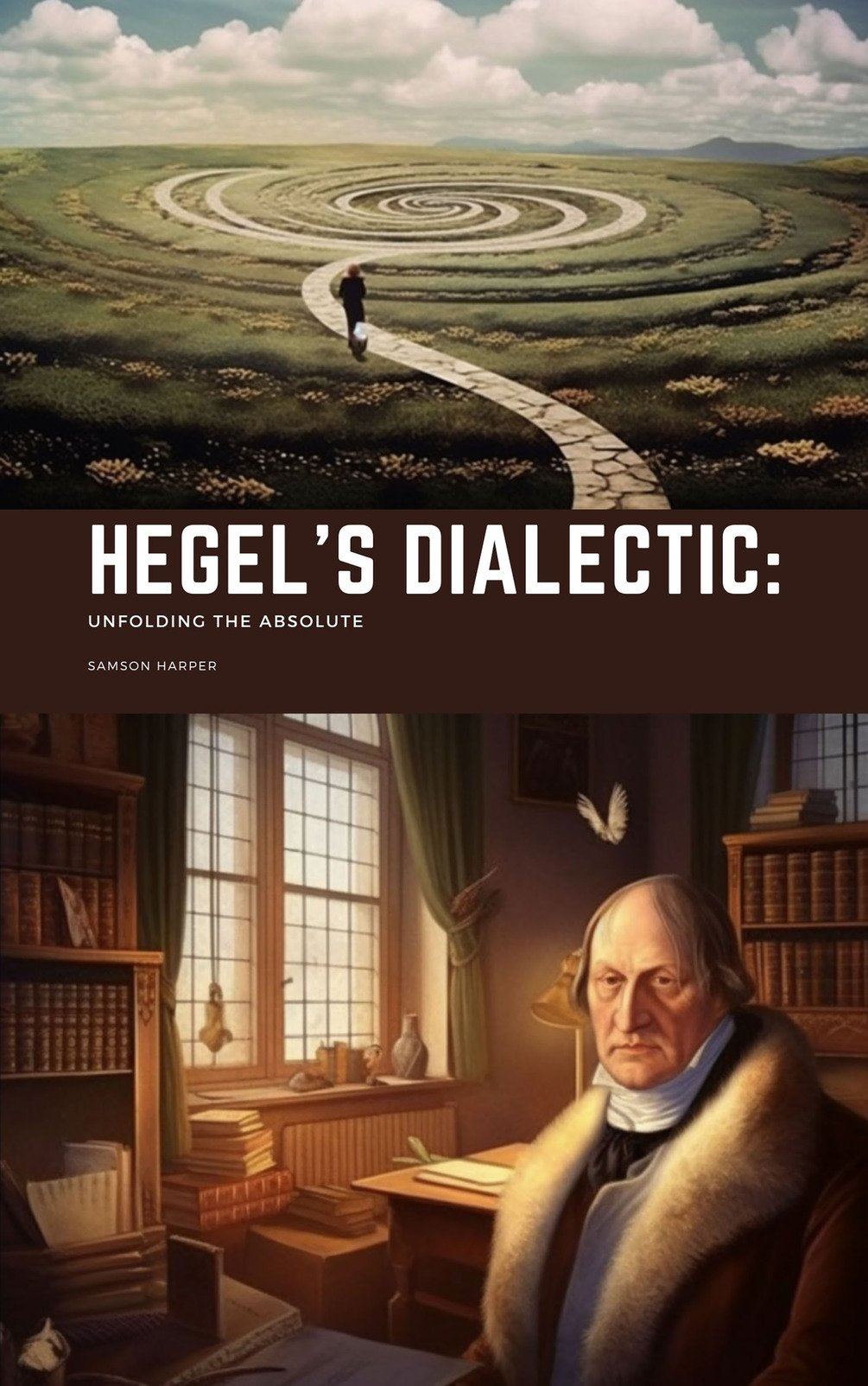

Hegel's Dialectic: Unfolding the Absolute - By Samson Harper
Explore Hegel's life, dialectical reasoning, and philosophy in detail. Delve into his influential works and legacy. A must-read for philosophy enthusiasts.
📖Introduction to Hegel's Dialectic
Welcome to the captivating world of German philosopher Georg Wilhelm Friedrich Hegel. "Hegel's Dialectic: Unfolding the Absolute" by Samson Harper is a comprehensive journey through the complex yet fascinating landscape of Hegelian thought. This book offers an intricate exploration of Hegel's life, his philosophical upbringing, and the enduring influence of his ideas. You will dive deep into the essence of Hegel's 'Absolute,' understand the mechanics of dialectical reasoning, and grasp his profound notions of 'Spirit' and historical progress. The book meticulously discusses Hegel's significant works, including 'The Phenomenology of Spirit' and 'Elements of the Philosophy of Right,' providing insightful analysis on themes like self-consciousness, freedom, and the state. Additionally, it examines Hegel's impact on Karl Marx and subsequent Marxist ideology, while also addressing the debates and controversies surrounding his philosophy. "Hegel's Dialectic: Unfolding the Absolute" concludes by reflecting on the lasting legacy of Hegelian philosophy and its relevance in contemporary intellectual discourse. Whether you are a seasoned philosopher or a curious newcomer, this book is an invaluable resource for anyone eager to delve into the depths of Hegelian thought.
📘In-Depth Exploration of Hegelian Thought
Delving deeper into Hegelian thought, it is crucial to appreciate the nuanced and multifaceted nature of Hegel’s philosophy. Hegel's exploration of 'Spirit' or 'Geist' is central to understanding his overall system. Spirit, as Hegel describes, is the manifestation of freedom and rationality in the world. It evolves through different stages, beginning with subjective spirit (individual consciousness), moving through objective spirit (family, civil society, and the state), and culminating in absolute spirit (art, religion, and philosophy).
Central to Hegelian philosophy is the notion of dialectical reasoning. Unlike traditional logic that adheres to static definitions, Hegel’s dialectics involves a dynamic process where contradictions are integral to the development of concepts and reality. This method allows for a higher synthesis that preserves the essence of opposing elements while transcending their limitations.
In 'The Phenomenology of Spirit', Hegel intricately outlines the journey of consciousness from sense-certainty, through perception and understanding, to higher forms of self-awareness and rational thought. This progression is marked by the resolution of conflicts inherent in each stage, propelling consciousness towards a fuller realization of its potential and ultimately, absolute knowledge.
Hegel’s historical philosophy posits that the course of human history reflects the unfolding of rational freedom. History, thus, is a teleological process where the realization of freedom is the ultimate end. Each historical epoch represents a dialectical movement that advances the development of human freedom, with contemporary society being the latest stage in this continual progression.
Furthermore, Hegel's influence extends significantly to political philosophy. His views on the state as the realization of ethical life highlight the importance of collective freedom over individualism. By aligning individual interests with the rational will of the state, Hegel envisions a harmonious society where true freedom is achieved.
Hegelian philosophy has left an indelible mark on various schools of thought. Existentialists like Sartre and Heidegger have engaged deeply with Hegelian themes. Likewise, phenomenologists and critical theorists have found in Hegel a rich source for developing their ideas. Even today, Hegel's intricate analysis of reality, consciousness, and historical progress provides invaluable insights for contemporary philosophical debates.
"Hegel's Dialectic: Unfolding the Absolute" is an essential read for anyone looking to immerse themselves in this profound and transformative philosophy.
🔍Main Arguments of Hegel's Dialectic
🔍Main Arguments of Hegel's Dialectic
Georg Wilhelm Friedrich Hegel's philosophy is a profound exploration of the dynamics of reality, experience, and consciousness. At the core of Hegelian thought is the concept of the 'Absolute' – an all-encompassing reality that unfolds through a dialectical process. This process is characterized by a triadic structure of thesis, antithesis, and synthesis, through which contradictions are sublated to create a higher understanding of truth.
Hegel’s dialectic is not just a method but a reflection of the dynamic and self-developing nature of reality itself. In 'The Phenomenology of Spirit', Hegel examines the development of self-consciousness, beginning from simple sense experience to absolute knowing. Through this journey, consciousness progresses by overcoming various stages of alienation and contradiction, ultimately realizing its unity with the Absolute.
One of Hegel’s most discussed contributions is his idea of historical progress. According to Hegel, history is the unfolding of Spirit (Geist), wherein each epoch represents a stage in the development of human freedom and self-consciousness. This is vividly elaborated in 'Elements of the Philosophy of Right', where Hegel articulates the relationship between individuals, civil society, and the state. Here, he posits that true freedom is found not in individual autonomy but in the alignment of individual will with the rational will of the state.
Hegel’s influence on Karl Marx is significant, particularly the concept of dialectical materialism. While Hegel’s dialectic deals with the realm of ideas, Marx applied it to material conditions, seeking to explain societal changes through the conflict between different economic classes.
Beyond Marx, Hegel’s philosophy has sparked a myriad of interpretations and controversies. Critics have accused Hegel of mysticism due to his abstract concepts, while others have appreciated his profound impact on existentialism, phenomenology, and political theory. Today, Hegelian themes continue to pervade contemporary philosophical debates, whether in discussions of modernity, identity, or global ethics.
In summary, Hegel's philosophy presents a dynamic and intricate vision of reality, consciousness, and history, urging readers to consider the ongoing dialectical process that shapes human understanding and freedom.