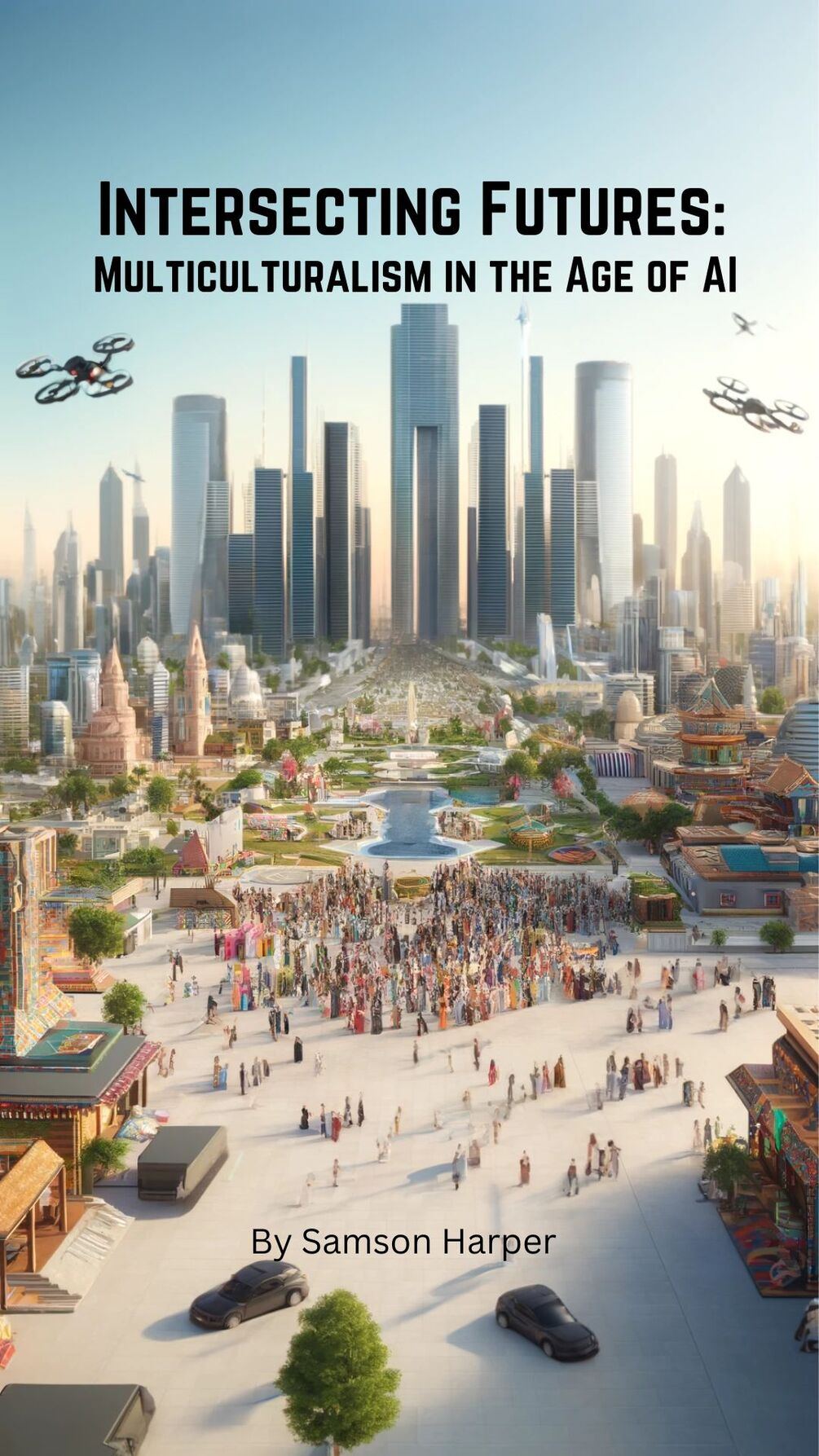

Intersecting Futures: Multiculturalism in the Age of AI
Discover 'Intersecting Futures,' a visionary book by Samson Harper exploring the integration of AI and multicultural inclusivity. A must-read for forward-thinkers.
📘Explore the Future with 'Intersecting Futures'
As we stand on the brink of monumental technological and social changes, 'Intersecting Futures: Multiculturalism in the Age of AI' by Samson Harper invites you to explore a visionary perspective on the synthesis of AI technology and multicultural inclusivity. This thought-provoking book not only offers theoretical insights but also practical visions of a world where AI supports and enhances the fabric of human experience, ensuring that every voice is acknowledged and preserved. By delving into the potential futures that await us, Harper masterfully presents a reality where society unconditionally supports each individual, fostering a non-dual, accepting community. Whether you're an AI enthusiast, a champion of multicultural issues, or simply a curious reader seeking to understand the next wave of societal transformation, this book promises to be a compelling and inspiring read.

🌍AI as a Cultural Ally
🤖The Heart of 'Intersecting Futures'
In 'Intersecting Futures: Multiculturalism in the Age of AI,' Samson Harper dives deep into the convergence of artificial intelligence and multiculturalism, presenting a futuristic vision that challenges conventional approaches. Harper's main arguments revolve around the transformative potential of AI to not just coexist with but actively support the diverse cultural tapestry of human societies. By envisioning AI as a supportive ally rather than a controlling force, the author outlines a future where technology amplifies human potential and fosters inclusivity.
One key argument is the idea that AI can serve as an enhancement to cultural practices, enabling more personalized and meaningful interactions within diverse communities. Harper illustrates how AI technologies can help preserve and promote cultural heritage, ensuring that even the most marginalized voices are empowered and heard. Furthermore, by democratizing access to knowledge and resources, AI can support the creation of societies where equity and inclusion are foundational principles.
Another critical point is the emphasis on non-dualistic thinking – a perspective that moves beyond binaries of us versus them. Harper advocates for a holistic approach, where AI not only assists but integrates within the fabric of society, creating a harmonious coexistence where differences are celebrated and collaboration is the norm. This book is a clarion call for a future where technological advancements are harnessed for the collective good, enriching the human experience and promoting a truly inclusive world.
🌉Expanding the Reach of AI
🌐Expanding Horizons with AI
'Intersecting Futures' goes beyond the surface-level discussions of AI and dives into the intricate ways in which artificial intelligence can significantly enrich our multicultural societies. Harper meticulously dissects various scenarios where AI is leveraged to foster community engagement, promote cultural understanding, and address social inequities. The author provides illuminating examples of AI applications in education, healthcare, and social services, showcasing how these technologies can bridge gaps and create more inclusive environments.
Further, the book explores the ethical considerations and potential pitfalls of AI implementation in multicultural settings. By addressing these critical issues head-on, Harper encourages readers to think deeply about the balance between technological advancement and cultural preservation. The narrative is a blend of optimism and caution, emphasizing the need for responsible AI development that prioritizes human values and inclusivity.
'Intersecting Futures' serves not only as a guide but also as an inspiration for policymakers, educators, technologists, and community leaders who are navigating the complexities of a rapidly evolving world. Harper's visionary insights provide a roadmap for building societies where AI acts as a cornerstone for multicultural harmony and collective progress.
⚖Ethical Considerations and AI
Ethics play a pivotal role in 'Intersecting Futures,' as Samson Harper accentuates the responsibilities that come with integrating AI into diverse cultural landscapes. The book delves into the ethical frameworks necessary to navigate potential pitfalls, such as biases in AI algorithms, data privacy concerns, and the equitable distribution of technological benefits. Harper advocates for a conscious and proactive approach to AI ethics, stressing the importance of community involvement in shaping the technologies that will govern our shared futures.
By addressing these ethical dimensions, 'Intersecting Futures' provides readers with a comprehensive understanding of both the opportunities and challenges that lie ahead. Harper's thoughtful considerations remind us that while AI has the potential to catalyze significant positive change, it must be developed and implemented with utmost care to uphold the values of equity, integrity, and inclusivity. This holistic perspective ensures that the integration of AI into multicultural societies is not only technologically advanced but also ethically sound and socially beneficial.
🏥Transformative Potential in Education and Healthcare
Samson Harper's 'Intersecting Futures' eloquently explores the transformative potential of AI in critical sectors such as education and healthcare. The book envisions educational environments where AI-driven personalized learning plans cater to the unique needs of each student, enabling educators to provide more effective and inclusive instruction. Harper highlights real-world examples of AI being used to promote cultural literacy and competency, helping students develop a deep appreciation for diverse perspectives and histories.
In the realm of healthcare, Harper discusses how AI technologies can revolutionize patient care and public health initiatives. From predictive analytics that improve diagnosis and treatment plans to AI-driven platforms that provide culturally sensitive health information, the book paints a picture of a future where healthcare is more accessible, equitable, and responsive to the needs of diverse populations. By illustrating these advancements, Harper underscores the importance of embedding multicultural considerations into the development and deployment of AI in these vital sectors.
Overall, 'Intersecting Futures' serves as a vivid roadmap, detailing how AI can be harnessed to create more inclusive, equitable, and empathetic systems that benefit all members of society. This forward-thinking approach presents a compelling case for the integration of AI and multicultural principles in our collective journey towards a better future.