
Kyoto + Osaka
Japan






Journals Transcribed
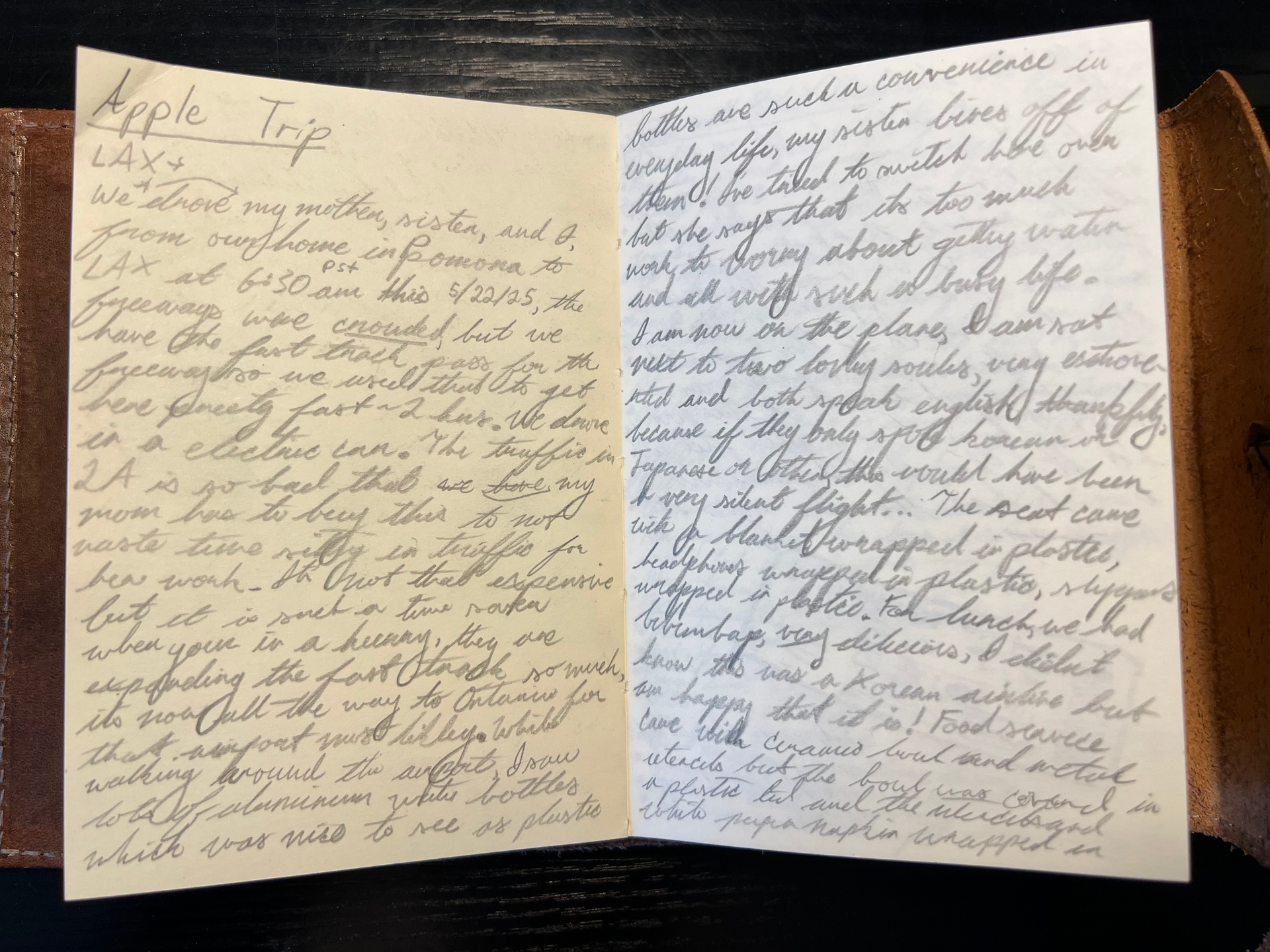
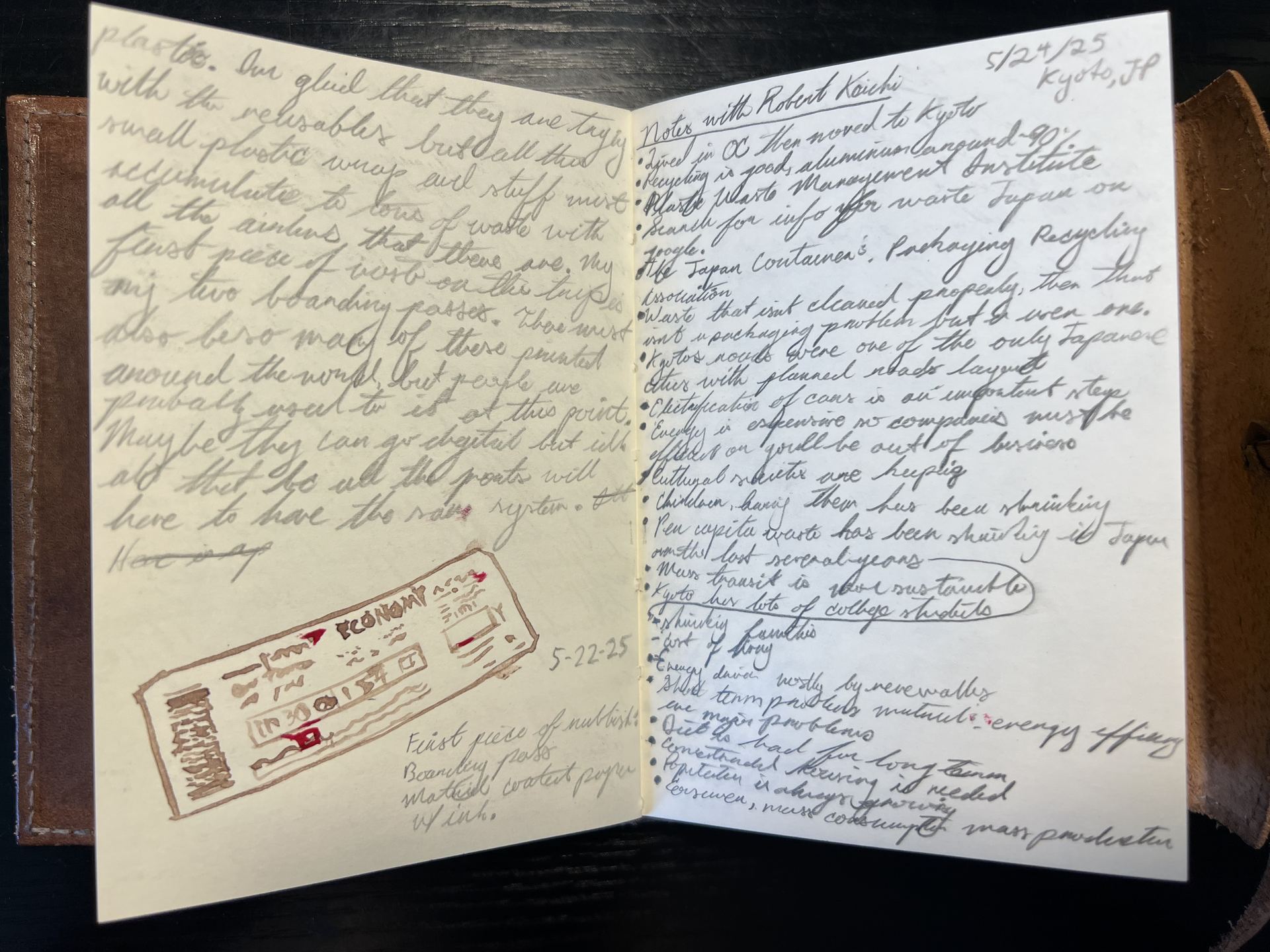
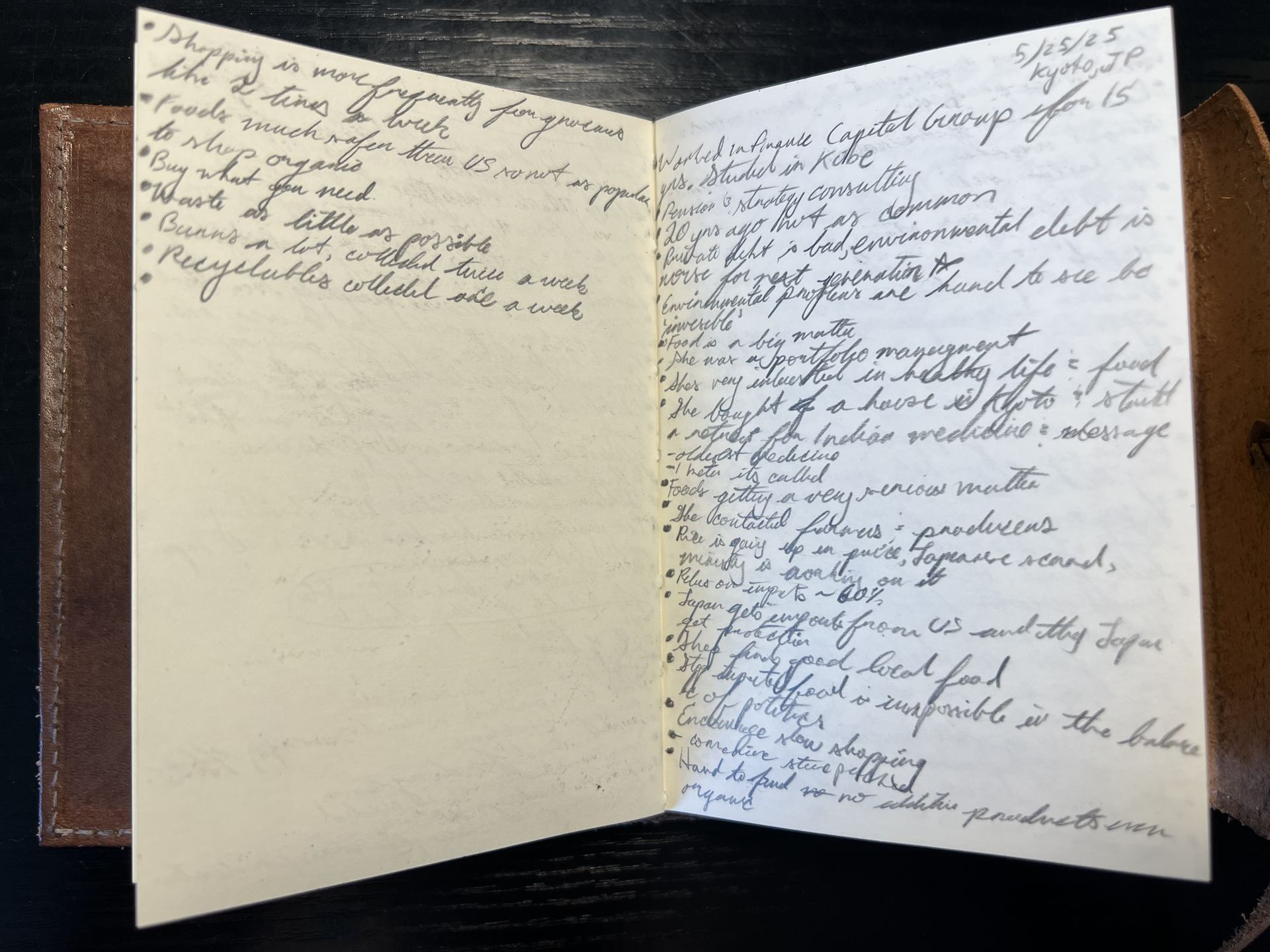
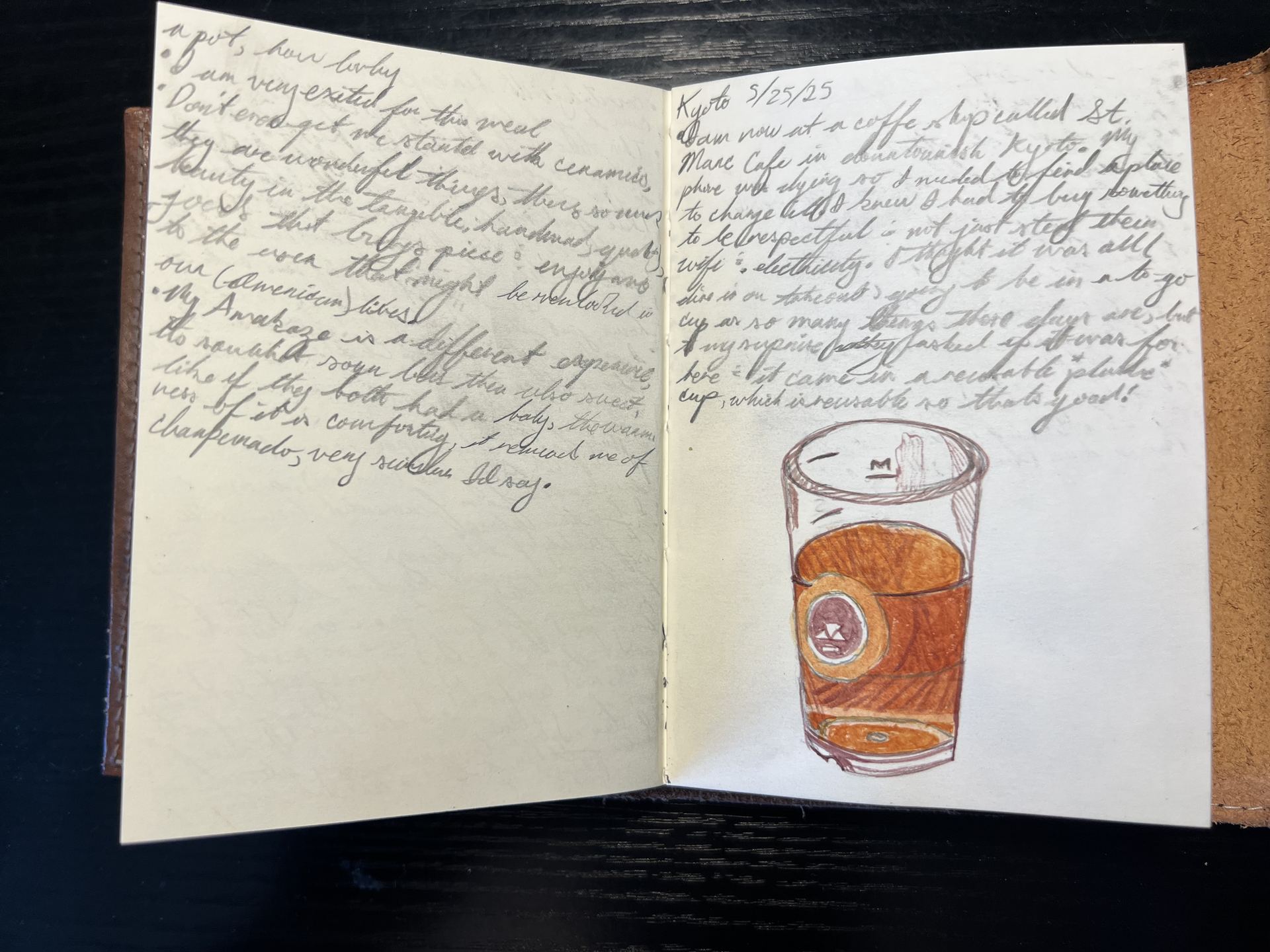
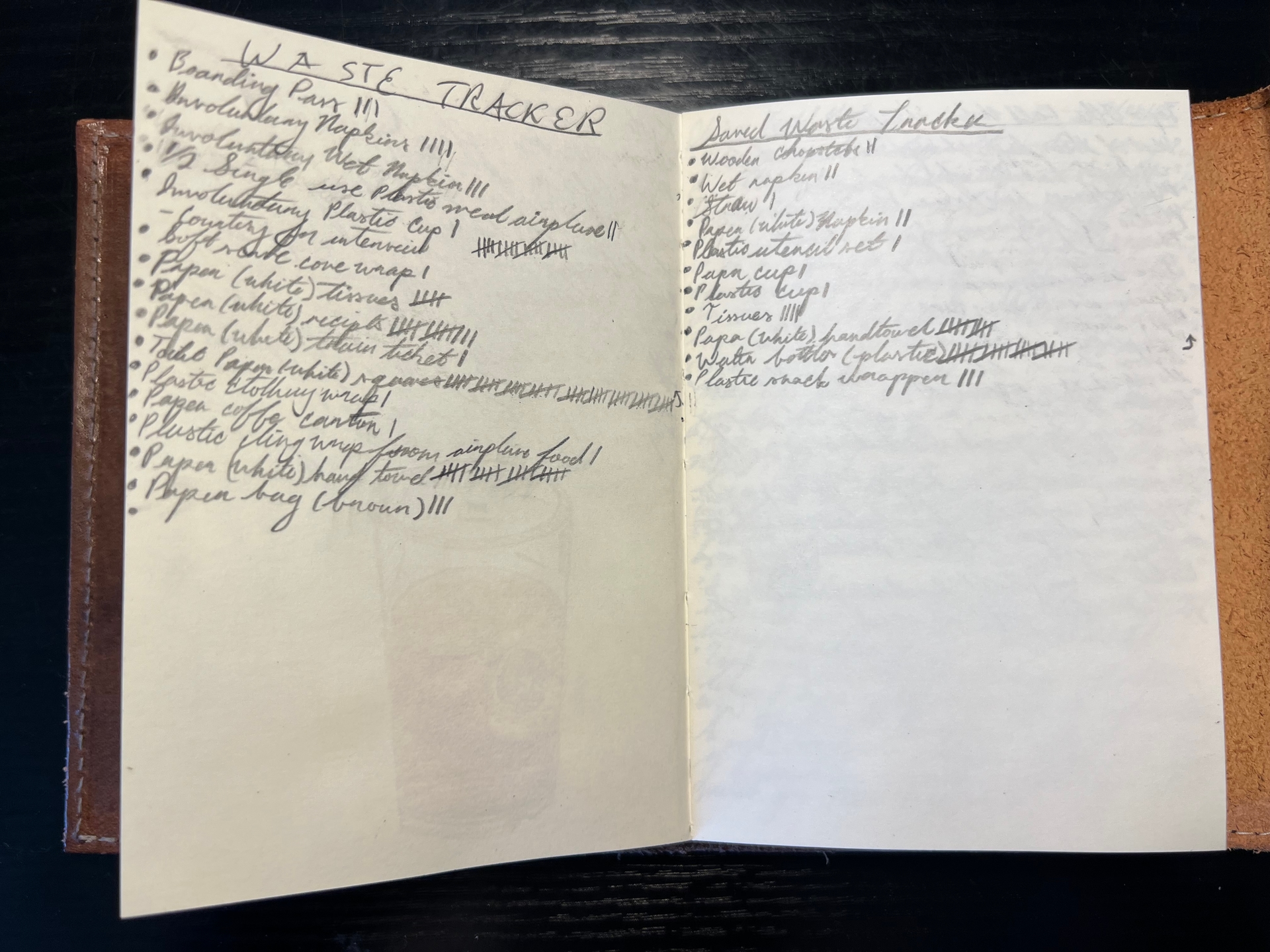
Note: In these sections of each subpage I will transcribe all relevant excerpts from my journal entries into text, creating easier readability for myself and site visitors. Whilst doing so, I will interpret and/or comment on some of my notes along the way. Please excuse my writing(grammar, spelling, errors, and more!) because I wrote most of these journals very quickly abroad and they serve as a way for me to quickly get my ideas, questions, and/or observations down on 'paper'.
My family dropped me off at the airport using our electric car and the use of our FastTrack pass, from Pomona to LAX
The freeways were extremely packed, typical for the LA region, tons of primarily petroleum burning cars on the roads
My mom purchased her FastTrack pass a couple years back as the traffic would cause her to have to plan her routes to work roughly 2x+ her normal driving times, they have recently added many more miles to the FastTrack system on the 10 Freeway
While walking around LAX, I saw many aluminum water bottles for sale, which was nice to see as their plastic counterparts have become such a convenience in many peoples lives
for example, my sister used to only purchase water for her drinking needs as she felt that it was a great way to ensure quality water compared to purchasing a water machine for her apartment and carrying heavy gallons for her use. She deemed that it would be very difficult to clean the water machine to optimal standards to not cause the growth of bacteria or other not very healthy things.
Now on my first flight of the trip, bound for Japan, my seat came with an airline blanket, headphones, and slippers wrapped in plastic, were off to a 'great' start!
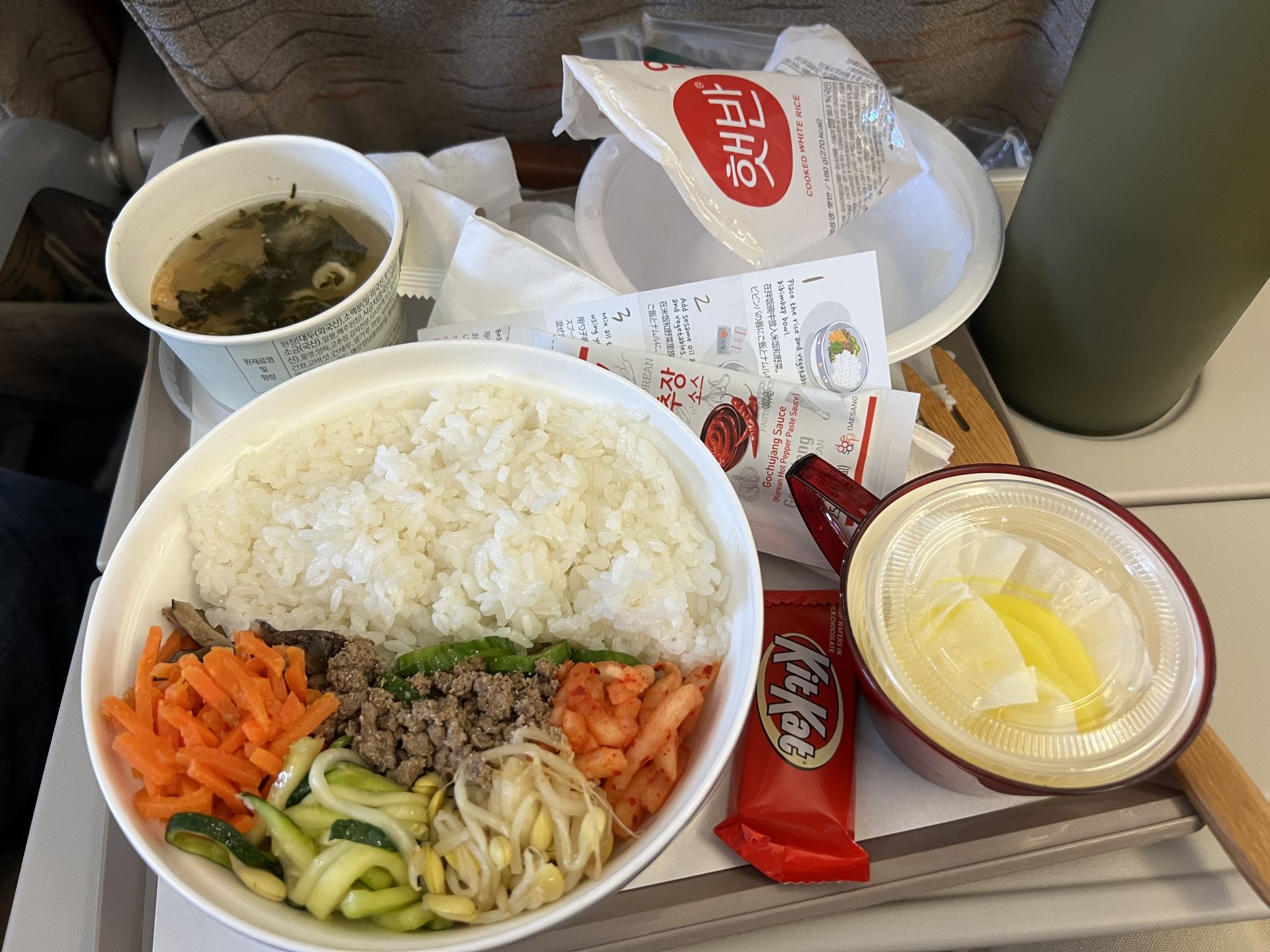
For lunch, we had bibimbap, it was very delicious! I would recommend everyone give it a try if they have yet to do so. Focusing on waste, a positive for this meal service was that the bowl of the main dish, the bibimbap, was to my surprise ceramic! This meal also came with metal cutlery! There also came a hard plastic mug for tea service, which I assume is reused by the airline as well. Apart from the previously mentioned reusables for my first look into a flight meal service, there came a reusable tray that the meal is served on. Now onto single-use disposables, there consisted of: the plastic lid that covered the bibimbap bowl, the plastic bag that sealed the cutlery set, the white paper napkins that were provided in plastic wrapping, along with my first-look into wet-wipes, which I later on found out is a norm in a majority of the Asian cultures that I got exposed to on my trip.
I'm very glad that my initial hypothesis that everything in flight meal services was single-use, was proven incorrect. I saw that this first airline has incorporated both reusables, and single-use disposables into their meal service. However, I can only begin to imagine the amount of single-use waste that is created by the thousands, or hundreds of thousands of meal-services provided on airlines yearly.
On the topic of air travel, another wasteful practice that I realized was taking place are boarding passes. These 9x4 inch pieces of paper were required for every passenger to board there plane. I image there are millions if not more of flights that take place each year and the amount of boarding passes created must be enormous. What first comes to mind is why not make them electronic? For example, to have them on your phone like a pass on Apple Wallet. However, I can imagine that people with the knowledge of how to use their phone wallets, which not all people have phone wallets, must be limited. Therefore, such an implementation would require education on the use of phone wallets and passes. Another constraint could be convenience, the ability to have a physical pass was nice as I just had to whip it out of my pocket when I was confused as to which gate I needed to be at or the time of departure for my flight. I also ended up folding them and struggling to find them at times when I had lots of other passes, documents and my wallet in my bag, so there is room for debate on wether or not to make boarding passes electronic.
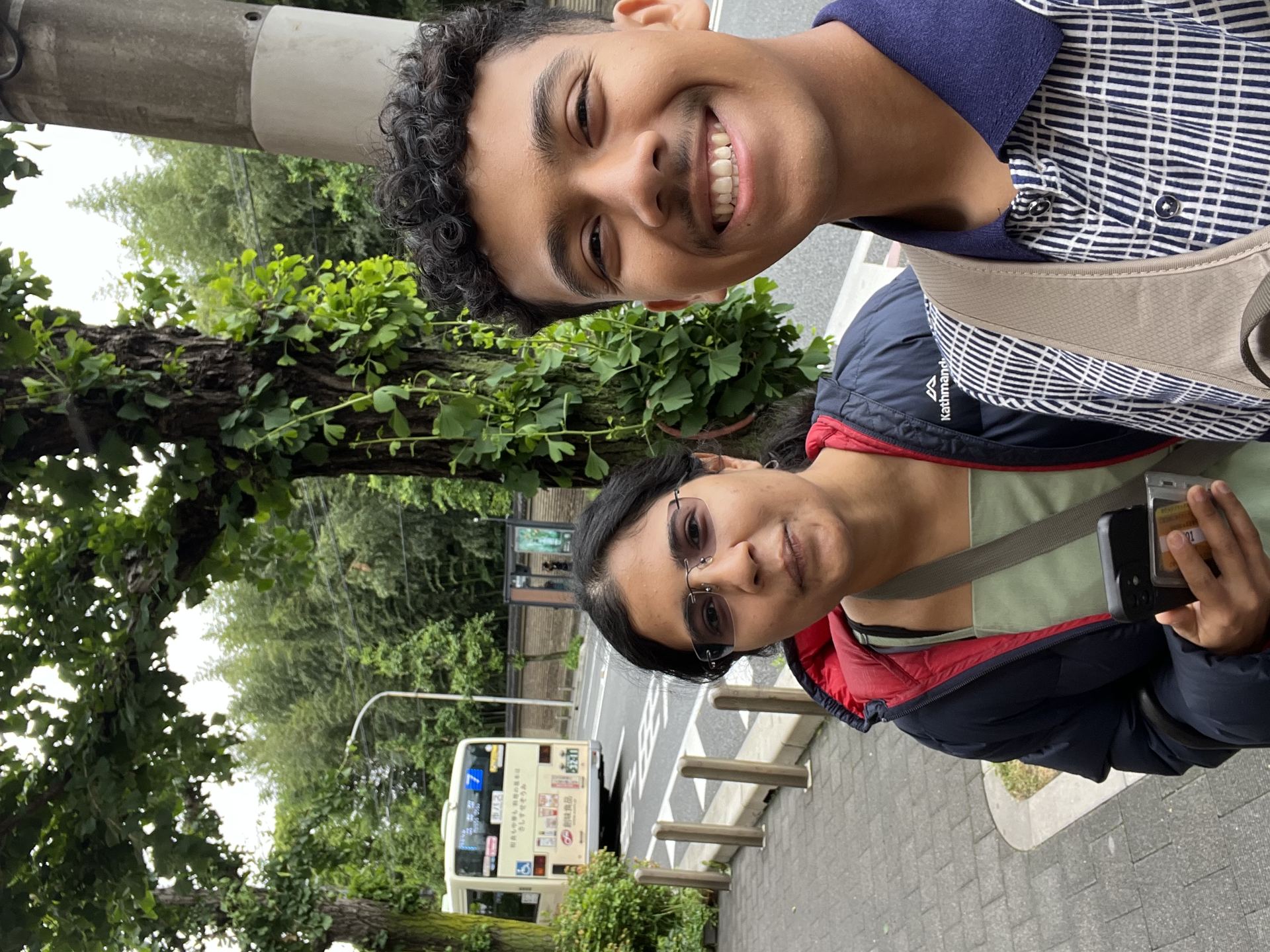
I almost missed the last bus departing from the Osaka airport to Kyoto. I arrived in Osaka pretty late at night, roughly around 11pm. I was thankfully one of the four other passengers on that bus that night. I met a soon-to-be friend, Diksha, who was heading to Kyoto for an academic conference. The bus that we took was diesel fueled. At 11pm, my options were very limited for transportation to Kyoto: the Airport Limousine Bus(which I took), a taxi, or a rental car. The limousine bus was the cheapest and most convenient at the time. However, during more normal hours, there would also be the Kansai Airport Express 'Haruka', a regular train, and other bus companies in service to Kyoto.
That night, (or shall I say morning, as I arrived at my hostel as 1am!) I stayed at a hotel near Kyoto Station as I had missed my check-in time for my hostel that I had booked for the next few days. I had forgotten to inform my hostel that I was going to get there after check-in time, however after a while of searching for a place to sleep at that night at 12am in Kyoto, Diksha let me know that there was availability at her hotel, and I thankfully managed to book a room there.
The following day, I checked into my hostel in the Higashiyama District of Kyoto(Kyoto Station is located in this district as well). It was a nice hostel located near a 7Eleven, and other conveniences. I then had to get going to my first interview. As I was running on a few hours of sleep as well as some time constraint as the interview was scheduled for the morning, I decided to take a taxi instead of public transport or walking as I would have gotten to my destination far to late. The taxis in Kyoto were of course more expensive than public transport as I sense will be the case almost everywhere nowadays.
Interview with Robert Kawaratani
Mr. Kawaratani is a CMC Alumnus from the class of 1972. He obtained a BA in Biology from CMC, followed by an MA in Biology(1974) and a D.env. in Environmental Science & Engineering(1978) from UCLA.
His experience includes working for the Electric Power Research Institute as a Project Manager, an Invited Researcher for the Central Research Institute of Electric Power Industry of Japan, a Specialist at Nihon Tetra Park K.K., an Environmental Management Services Manager at HAVI Global Solutions, and is now a Self Employed Environmental Consultant in Kyoto.
Mr. Kawaratani lived in Orange County before moving to Kyoto to further his career. I found this to be very valuable as I could ask him about his experiences in both California and Kyoto relating to sustainability and waste cultures.
We met at a coffee shop near where he lives called "Slow Jet Coffee in the Zoo" located in the Kyoto City Zoo. It was a charming place, the cafe seemed made for familys with kids as there were small tables for children and a play area as well. Mr. Kawaratani bought me an iced tea from the cafe, it came in a single-use plastic cup.
In respect to recycling, Mr. Kawaratani informed me that Kyoto recycling is good. For aluminum, around 90% gets recycled.
Plastic Waste Management Institute
The Japan Container & Packaging Recycling Association
When I asked him about some difficulties to recycling, he mentioned that the cleanliness of recyclables when placed into the recycling stream is a problem. However, he states: "waste that isn't cleaned properly isn't a packaging problem, it's a user problem."
Kyoto was one of the only cities with planned road layouts
Electrification of cars is an important step
Energy is expensive so companies must be efficient or they could be out of business
...
Child birth rates have been shrinking, shrinking families cost of living
Per capita waste has been shrinking in Japan over the last several years
Mass transit is more sustainable
Kyoto has lots of college students
Energy driven mostly by renewables
...
...
...
Population is always growing
Consumerism, mass consumption, mass production
Shopping is done more frequently for groceries, around twice a week
Food is much safer than in the US, therefore not much incentive to shop organic
He suggests we all buy only what you need and waste as little as possible
For waste disposal, Kyoto mainly burns the majority of its waste, burnable waste/common trash/waste is collected from homes twice a week, and recyclables are collected once a week
After our interview we parted ways and I ended up staying at the cafe to get lunch as it was around 1pm there local time. I ordered a teriyaki chicken sandwich, at this shop you orderd on a big screen that was located at the entrance and you can pay there as well, they give you a little buzzer to take to your table so that you know when your food is ready to be picked up, similar to Panera Bread here in the States. The sandwich came in brown wax paper wrapping. It was delicious!
After my interview with Mr. Kawaratani, I took the bus back to my hostel to unpack and settle in. When I got to the bus stop, I was confused on how to go about paying but I luckily ran into some foreigners who have been in Kyoto for a couple of weeks now and they helped me figure things out.
My first hostel stay which was at Backpackers Hostel K's House Kyoto, was enjoyable. It was clean, the customer service was excellent, and it seemed a sustainable way to travel, for both the environment and the wallet.
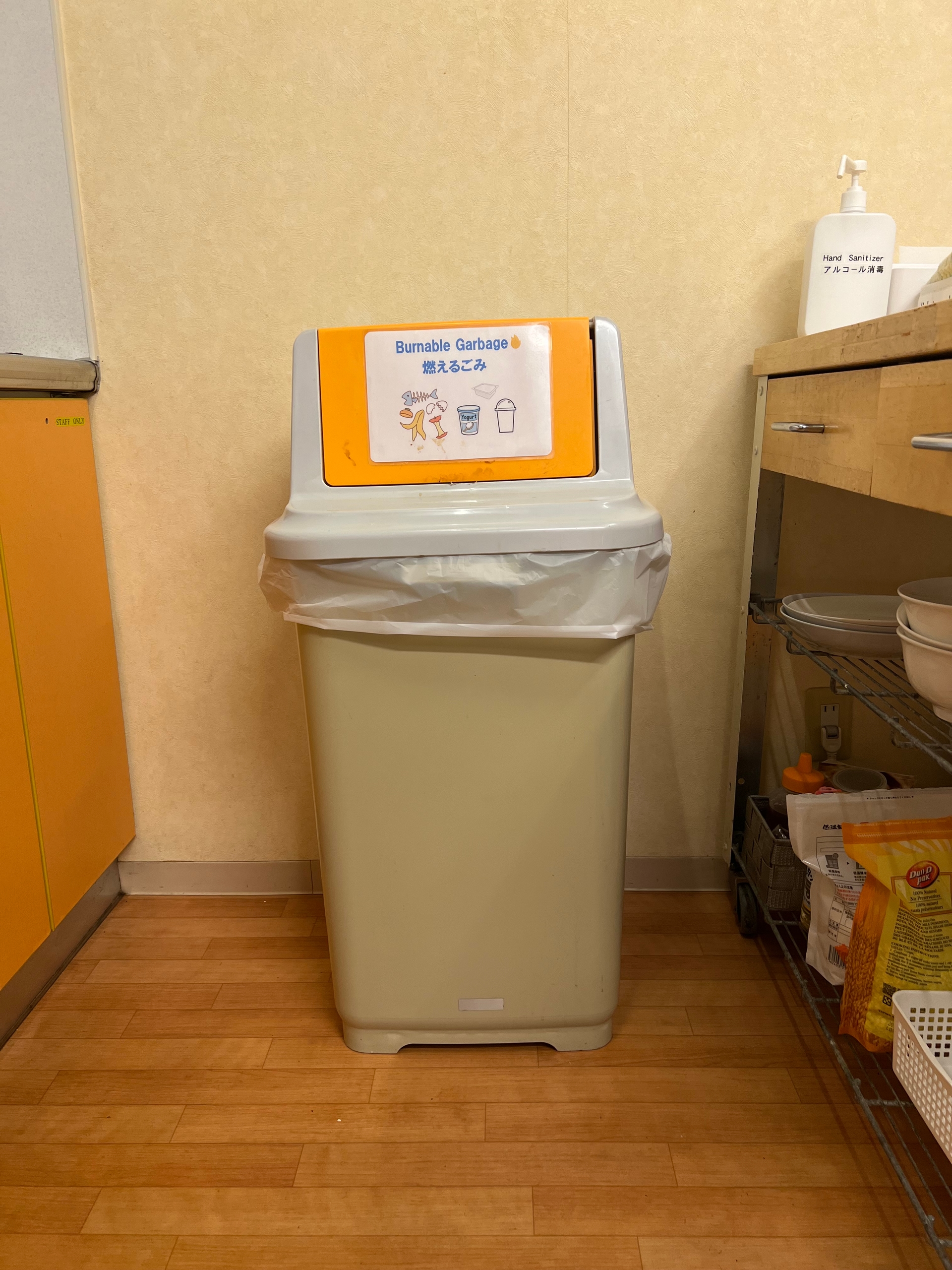
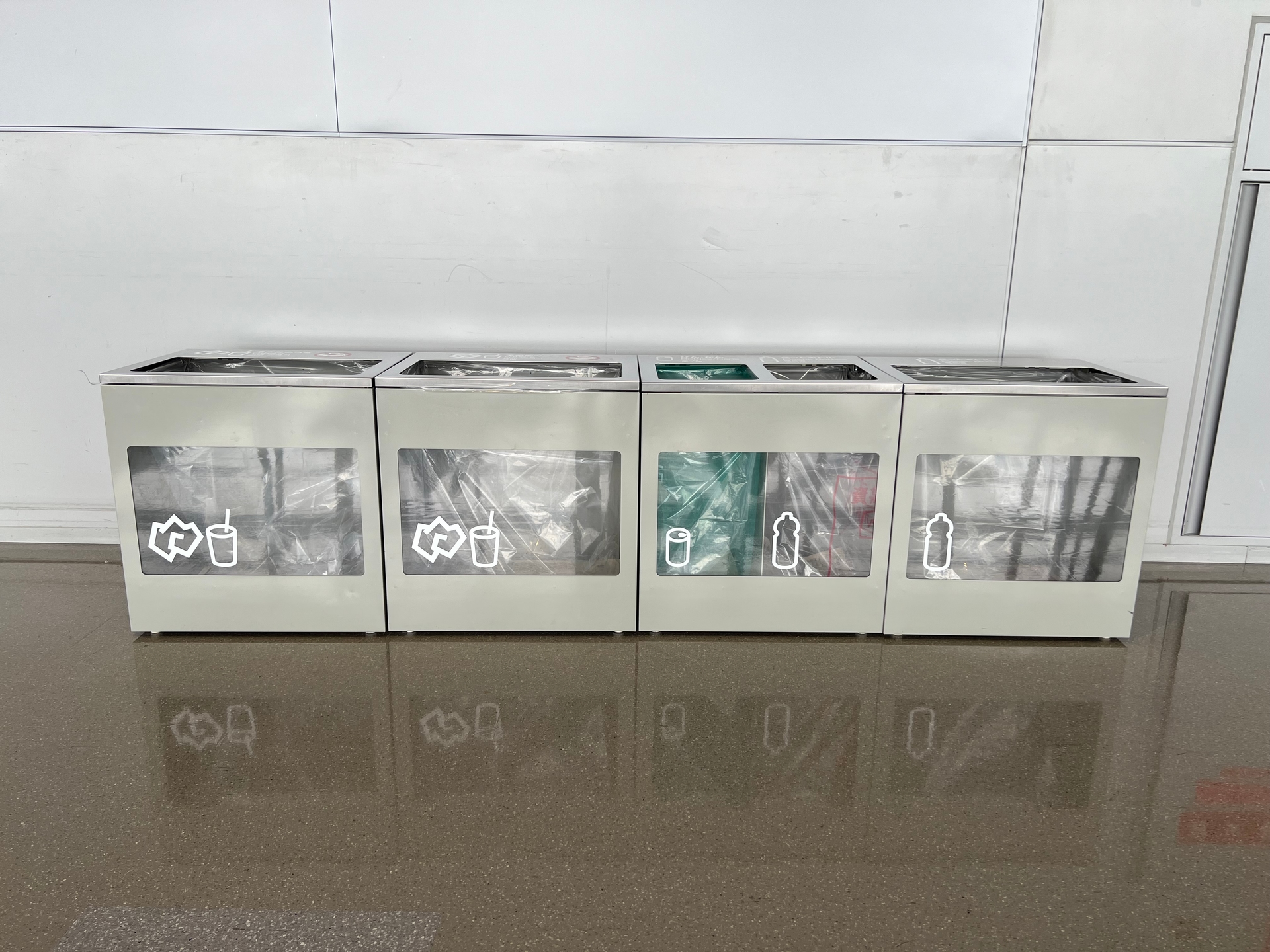
In the hostel, there were two bins in every room, a Burnable Garbage bin which had the following items depicted on it: a fish skeleton, the head of a carrot, the peel of a banana, the core of an apple, a container of yogurt, tofu wrapping, and a plastic to go cup with its lid. The other bin was a two-in-one bin, on the left side was written: "Only Cans & P.E.T bottles" (With images of aluminum cans, and plastic bottles, and an "X" over the images of a milk carton, liquid yogurt carton, a disposable coffee cup, a plastic egg carton, and some small plastic container); on the right side was "ONLY Glass bottles" (With the images of a wine bottle, a sake type bottle, and a tequila bottle, along with an "X" over the images of plastic bottles, aluminum cans, a small plastic container, and a disposable coffee cup).
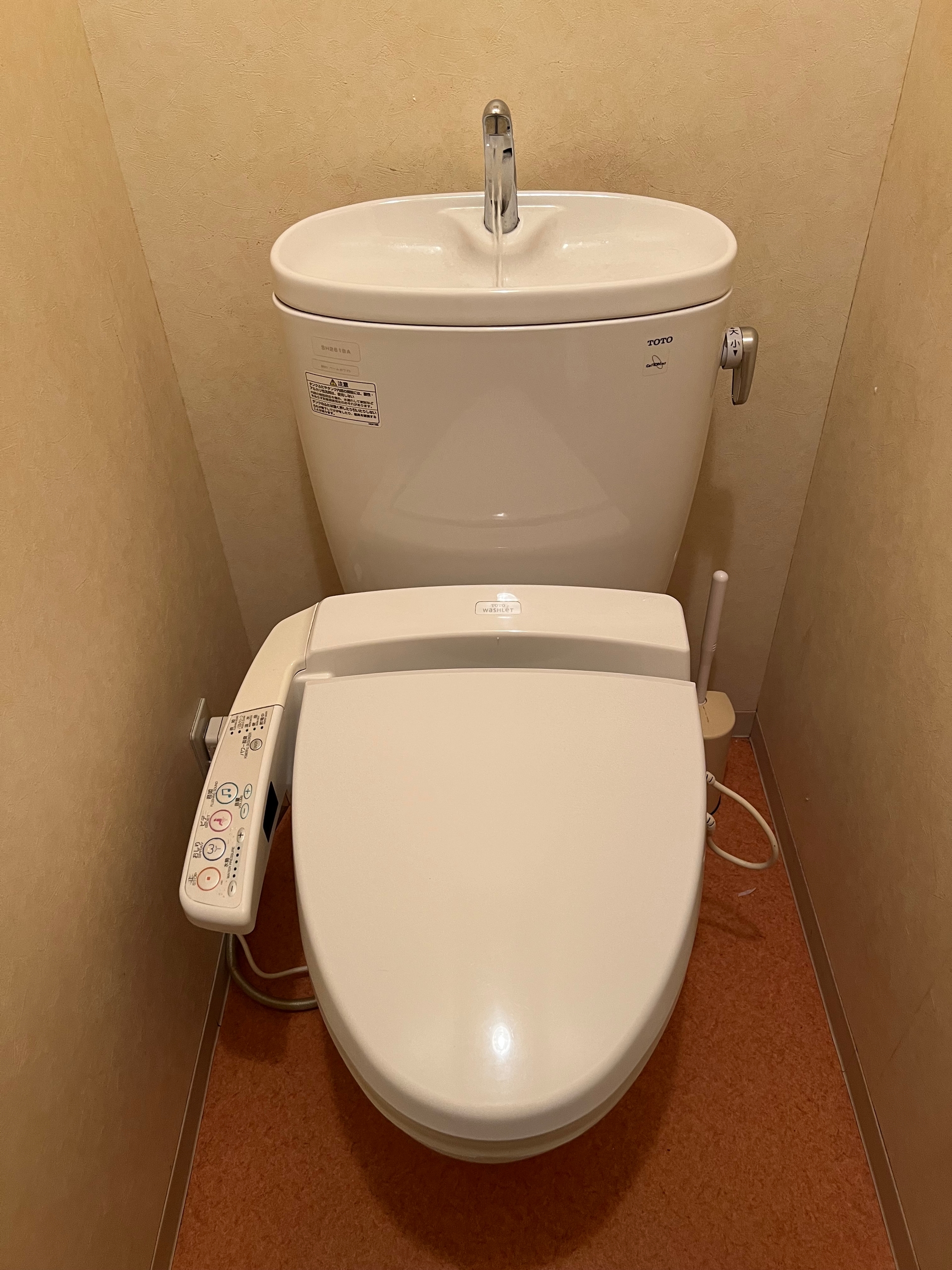
In the bathroom, the hostel had disposable white paper towels and a single-use plastic hand soap pump. It did not have an air hand dryer. It also had bidets in every toilet along with white toilet paper.
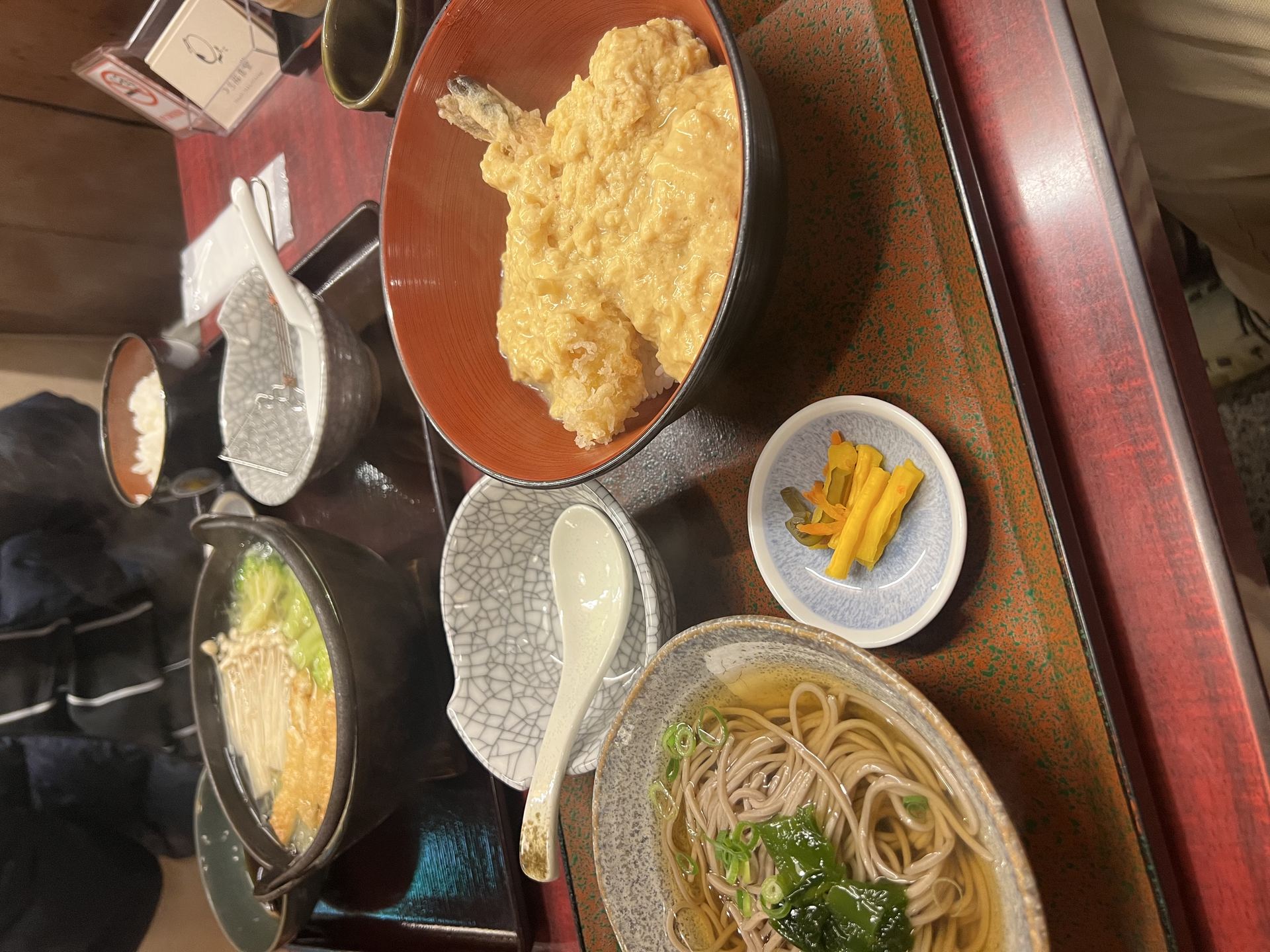
For dinner, I met up with Diksha and we stumbled upon a tiny traditional fashioned restaurant called Tsuchifuku Kawaramachi. This establishments specialty are Soba and Udon. I had deep fried shrimp(the most massive shrimp I've ever seen) with rice and a scrambled egg on top along with Soba and some pickled veggies. This meal was also very delicious! Each new party was greeted with warm green tea which was enjoyable.
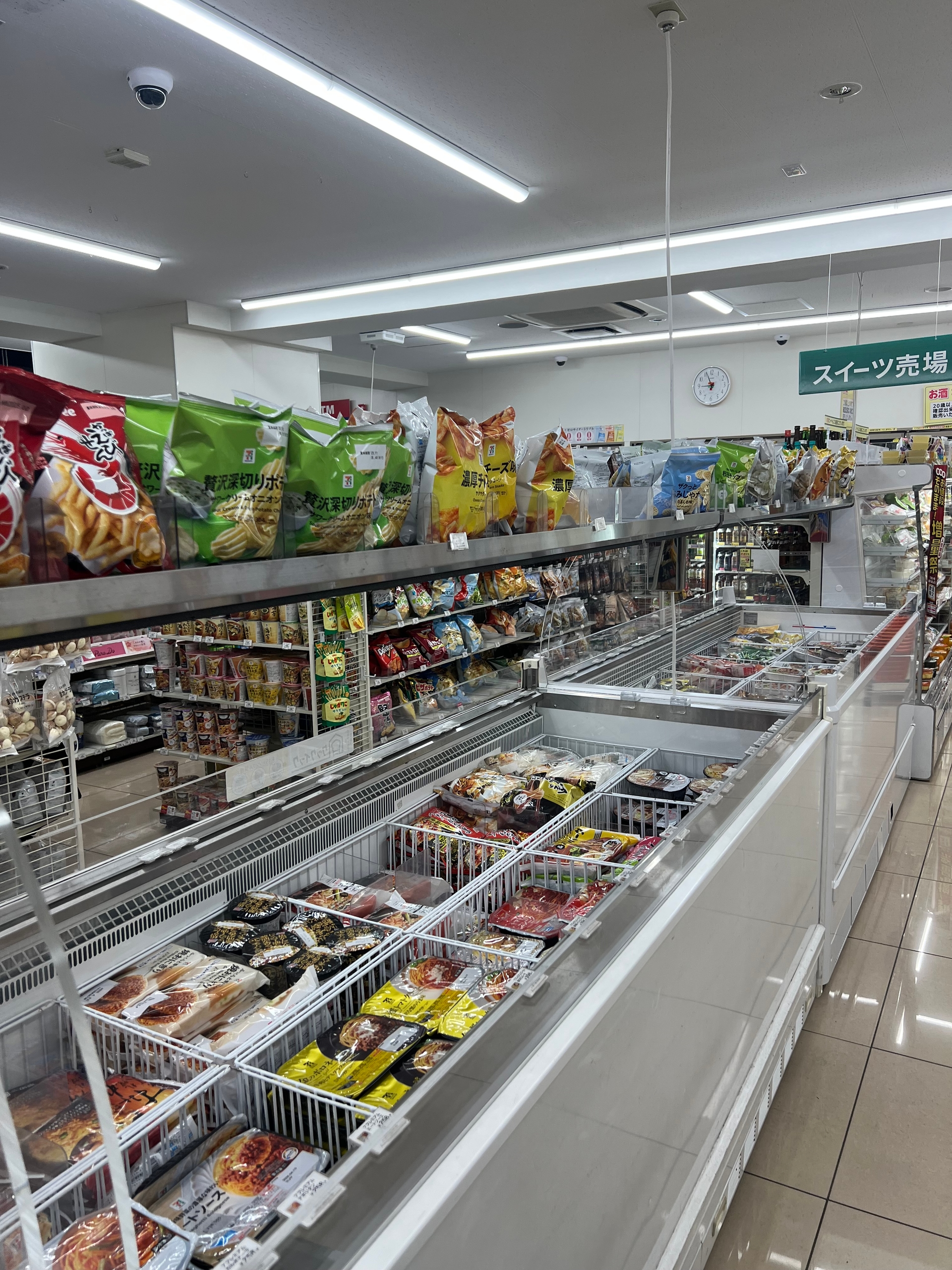
After dinner, we went to the iconic 7-Elevens of Japan.
Here I saw pre-packaged single-use plastic cups with heat sealed plastic lids atop them, all in different sizes and all filled with ice. These were to-go cups for iced coffee from the "Seven Café Iced Coffee." This seems efficient but also wasteful as maybe the thin plastic 'wrap' lids are discarded and replaced with a sturdy plastic to-go lid after purchase. There was also many plastic packaged food items which I found normal.
They also sold apple accessories and many department store like items.
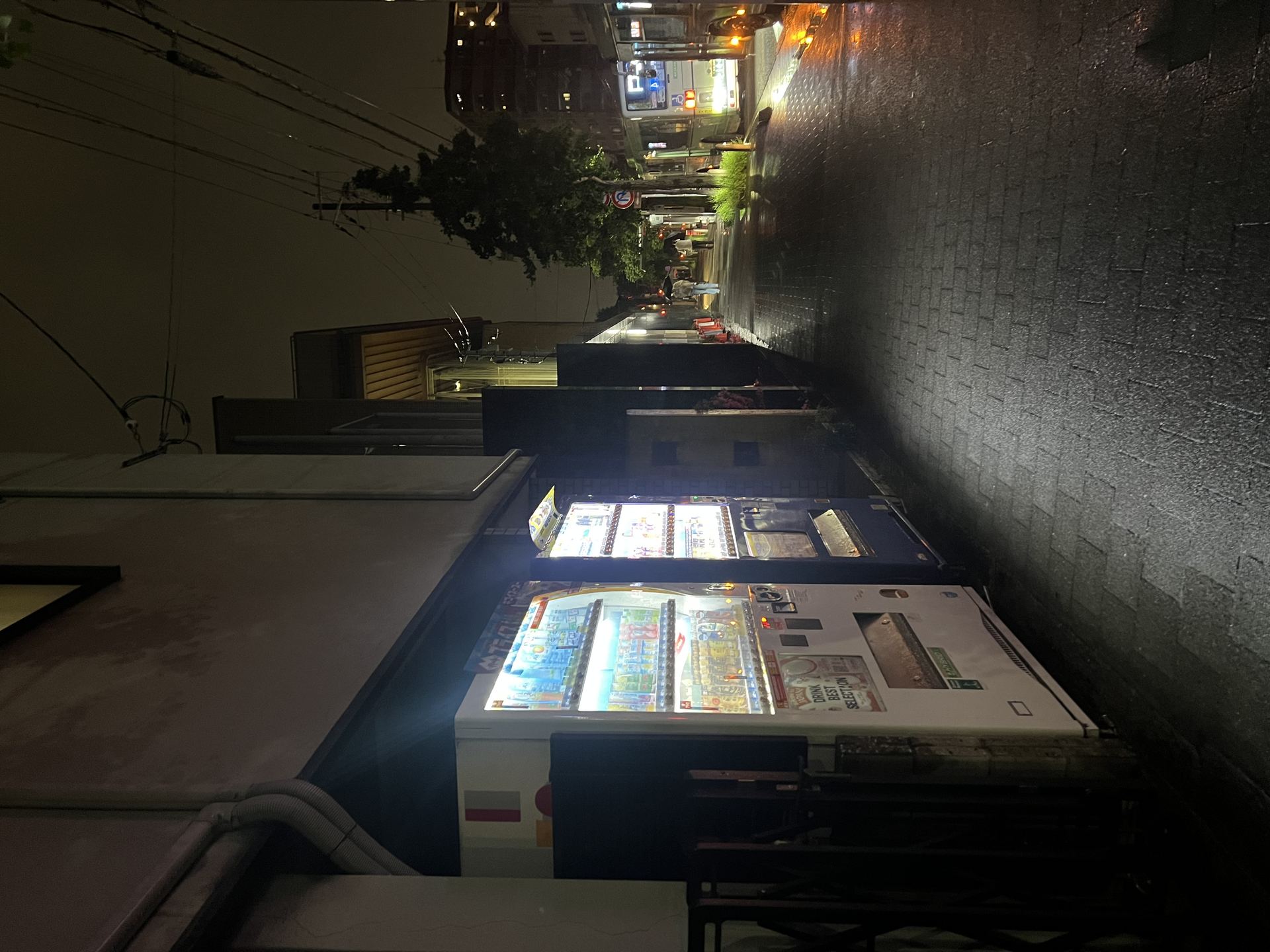
As I walked a back to my hostel, I recall such peace and quietness of the Kyoto streets. Mind you, I am near Kyoto Station, so this must be the more 'city' like area of Kyoto. The streets were spotless, wet because of the rain, and a nice vibe. I did run into a couple vending machines along the side of the road which offered cold drinks in single-use plastic bottles.
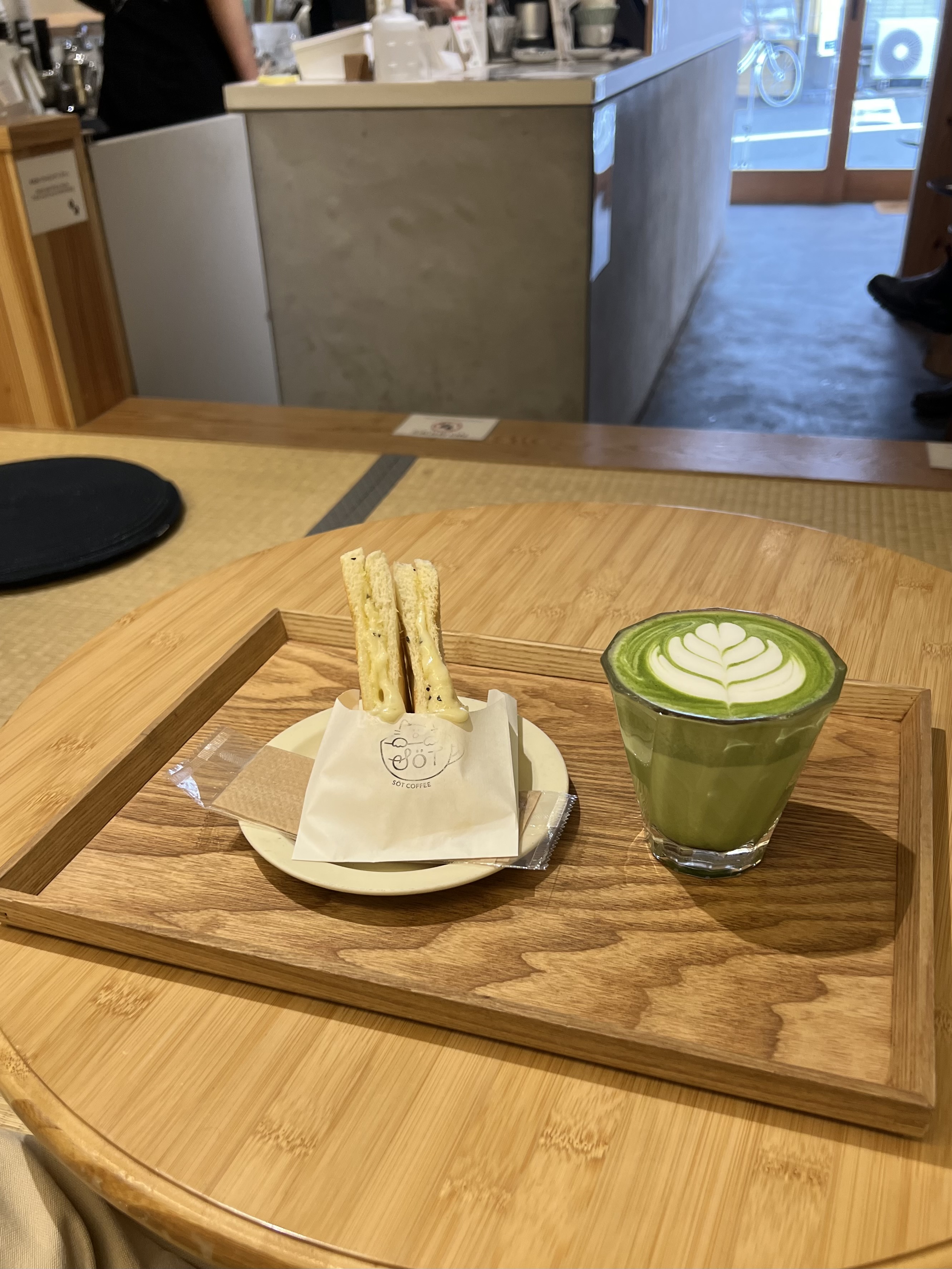
The next day I walked to a near-by cafe in the morning to get breakfast and a drink. I came across a place called "SOT COFFEE ROASTER Kyoto." It was a very nice, traditionally aesthetic place. It's owner is an Aussie who made my matcha latte that morning. For breakfast I ordered a grilled cheese sandwich, which came served in a little white paper bag atop a reusable small plate. Along with it came a plastic-packaged, brown, wet wipe. My latte came in a reusable glass cup as I had ordered my meal for dine-in. This meal was also very delicious!
A thought that comes to mind is how disposed of to-go packaging for take-out like in coffee shops must accumulate quickly, and by the tons. I assume one way to minimize such waste would be to dine-in at places like these. However, I know that the fast-paced society(s) that we live in, especially here in the Los Angeles area, would have a very hard time to implement, adjust, or live by such lifestyle.
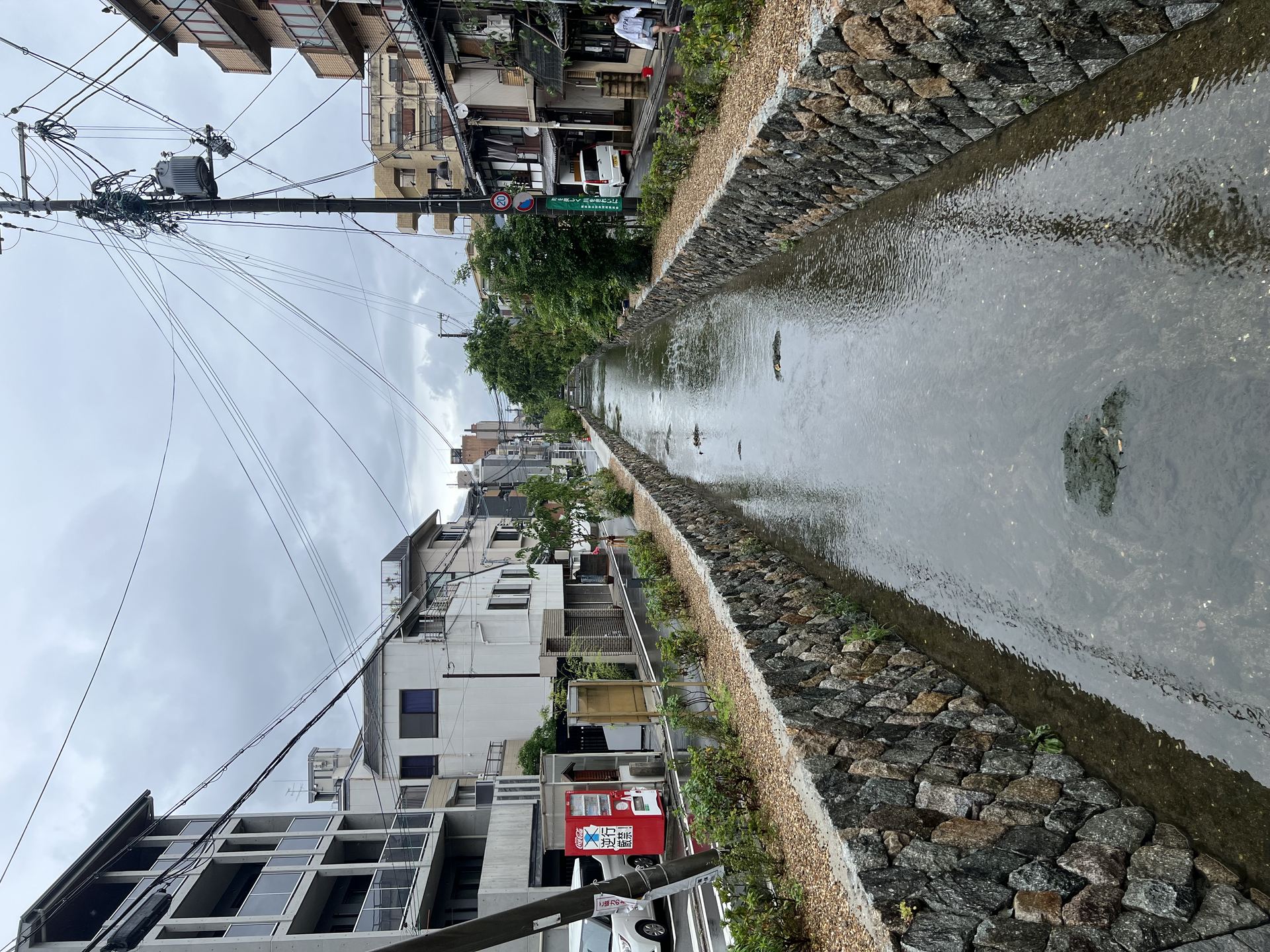
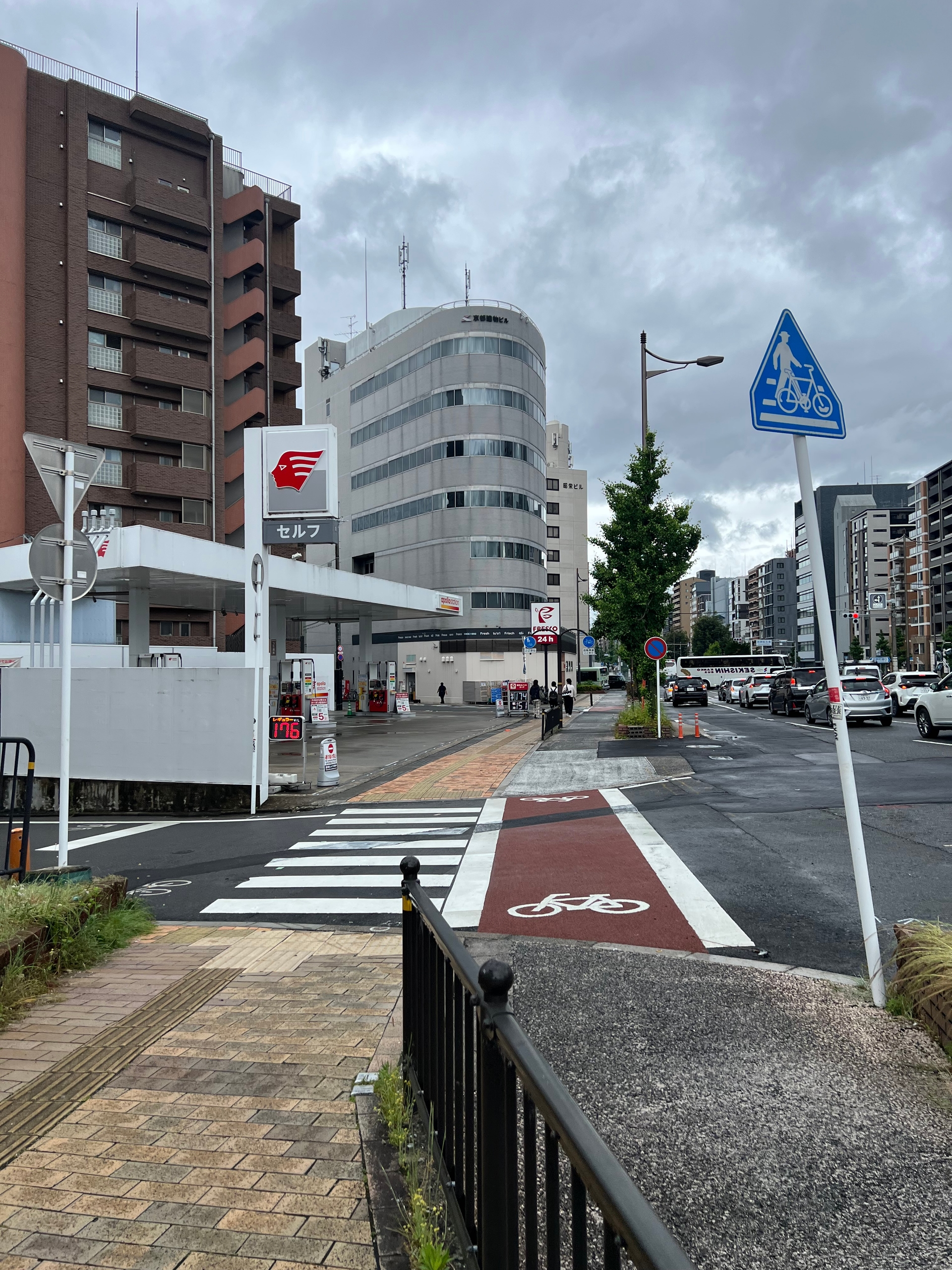
I now started to make my way to the first Zero-Waste shop of my trip on foot. On my roughly 30 minute walk, I noticed that there was a separated walking and bike lane on the 'sidewalk' of one of the main streets I took. The left side was for pedestrians and on the right was a dedicated bike lane with a different pavement and a small fence that divided the two paths. The street was then after a small flower bed that was positioned between the bike path and the street.
I had never seen such infrastructure before, here in Pomona and Claremont there are either bikes on the regular sidewalk or on the roads with a thin marked pathway alogn side the parked and moving cars.
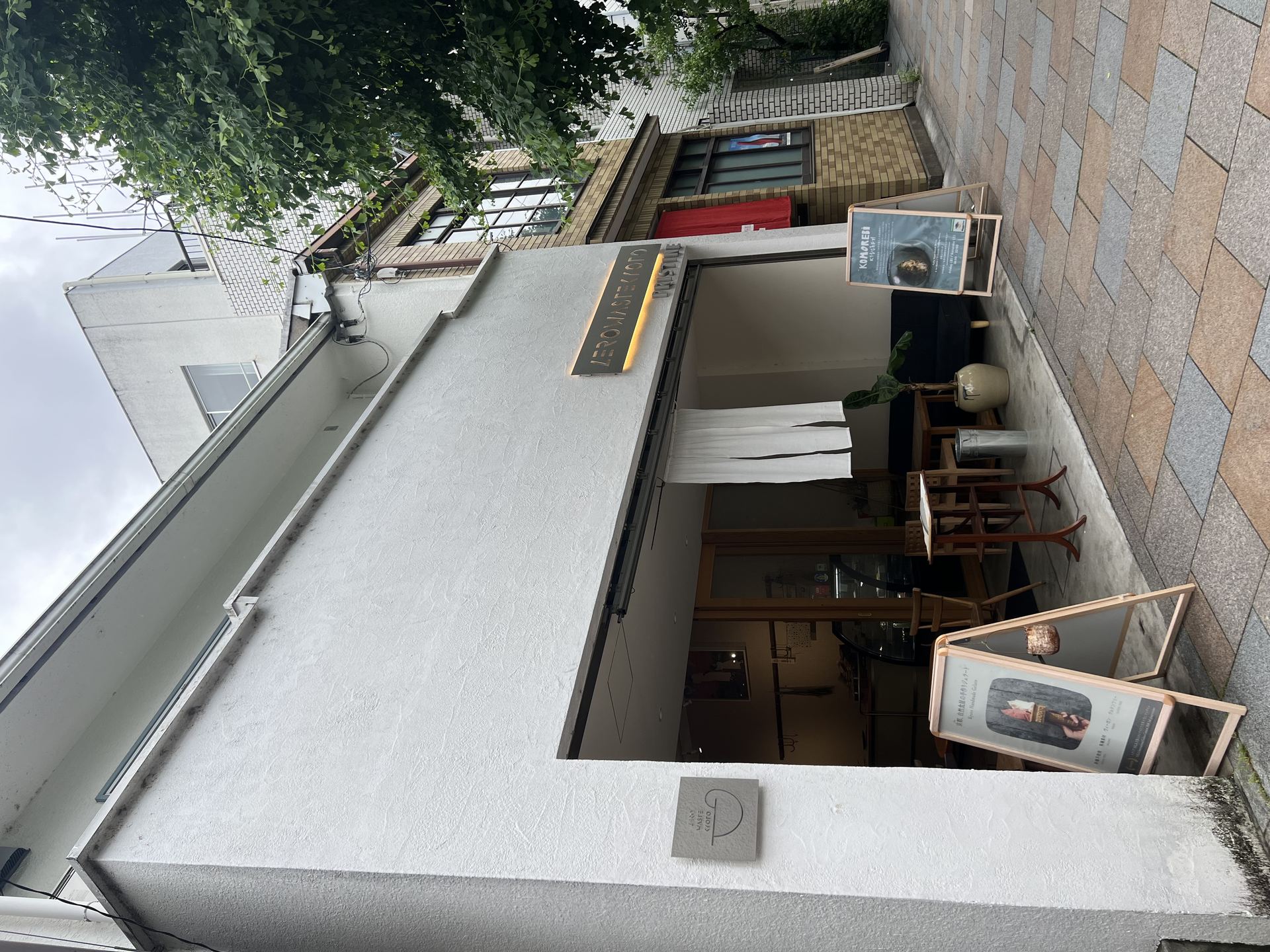
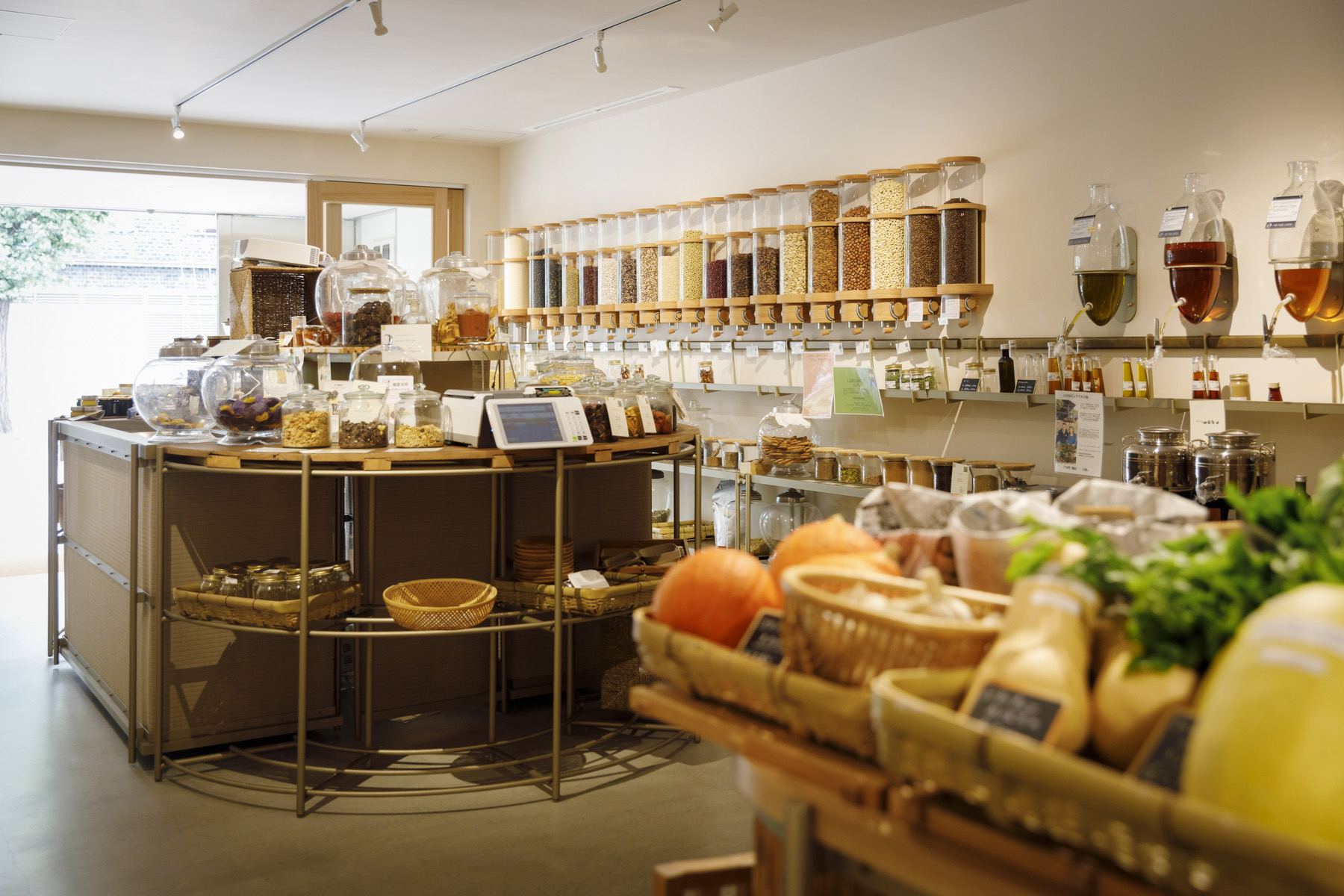
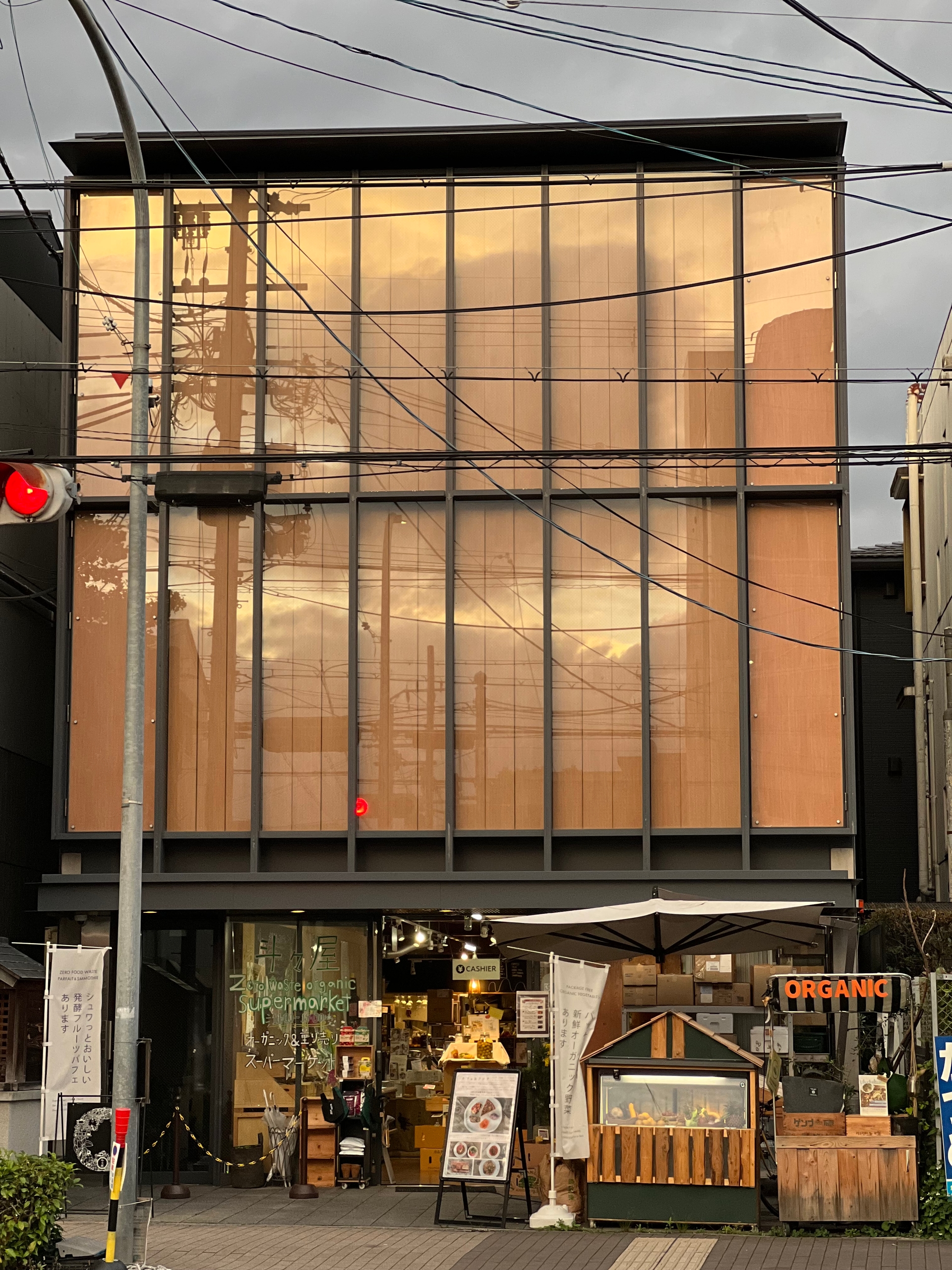
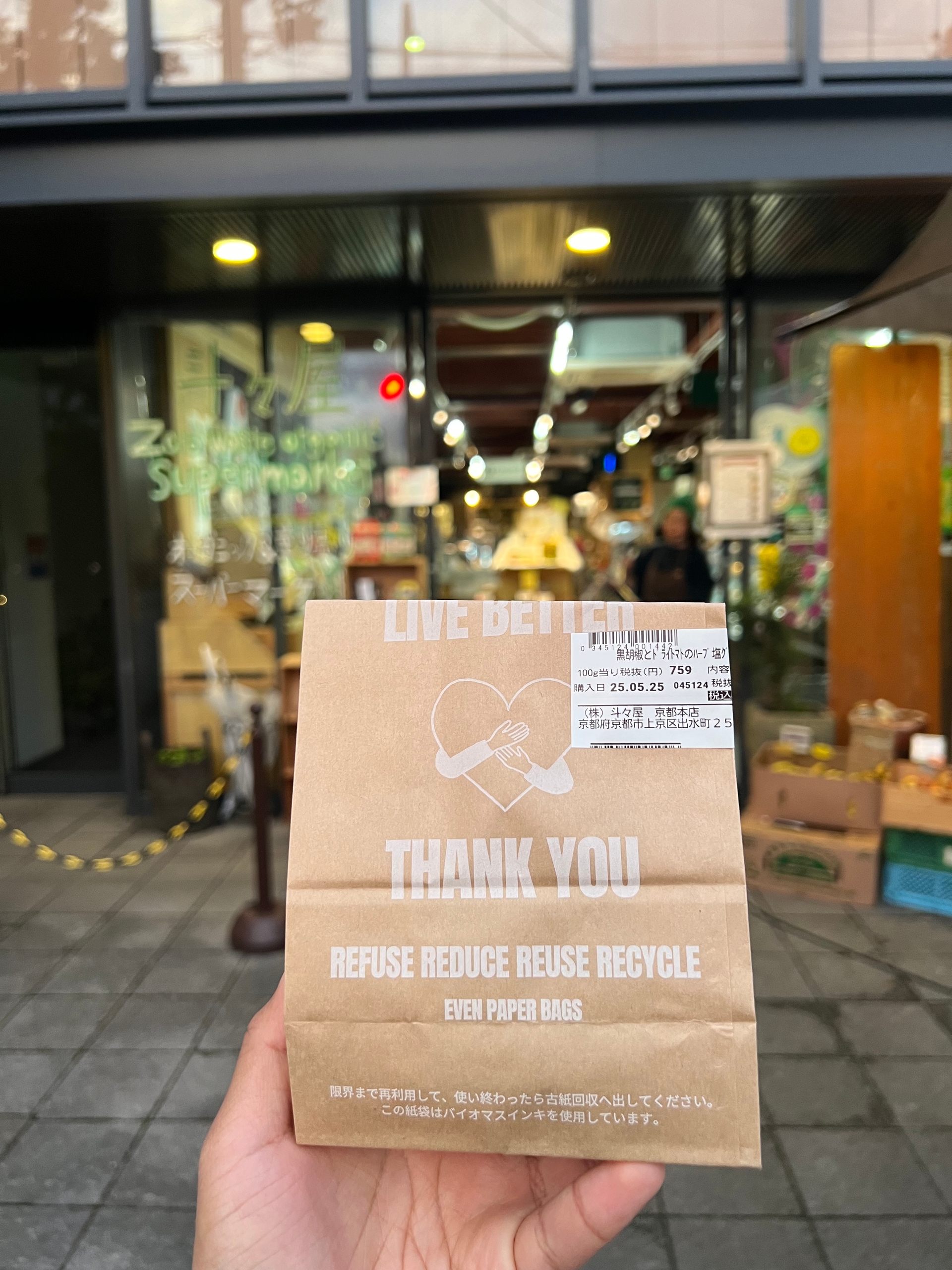
When I first set my eyes on Zero-Waste Kyoto I was in awe. The store front was beautiful in its simplicity and stillness. This was also due to the street that it sits on, a very calm(no surprise as it is Japan, and more specifically Kyoto) and more 'American' looking street. It reminded me somewhat of the Claremont Village. As I walked through the Noren, the curtains hung in the doorway, I was greeted by a very bougie zero-waste store. Everything was in glass containers and the whole shop was comprised of light earthy tones which created comfort and visual simplicity. I do believe that shopping and healthy habits are catalyzed by appeal and asthetics as well. I hope to dive into this during my research. I reached out to the shop owner and we sat for an interview.
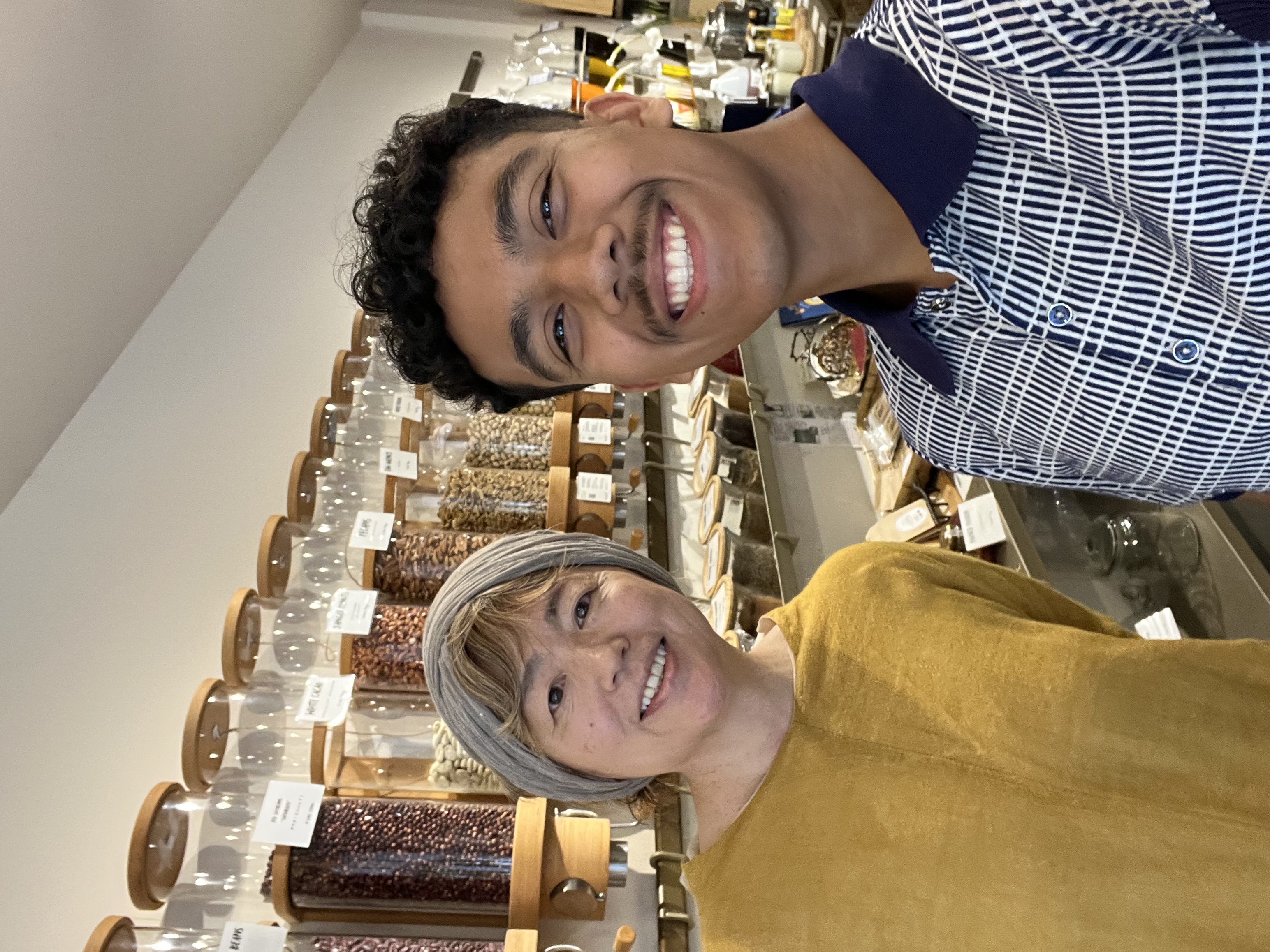
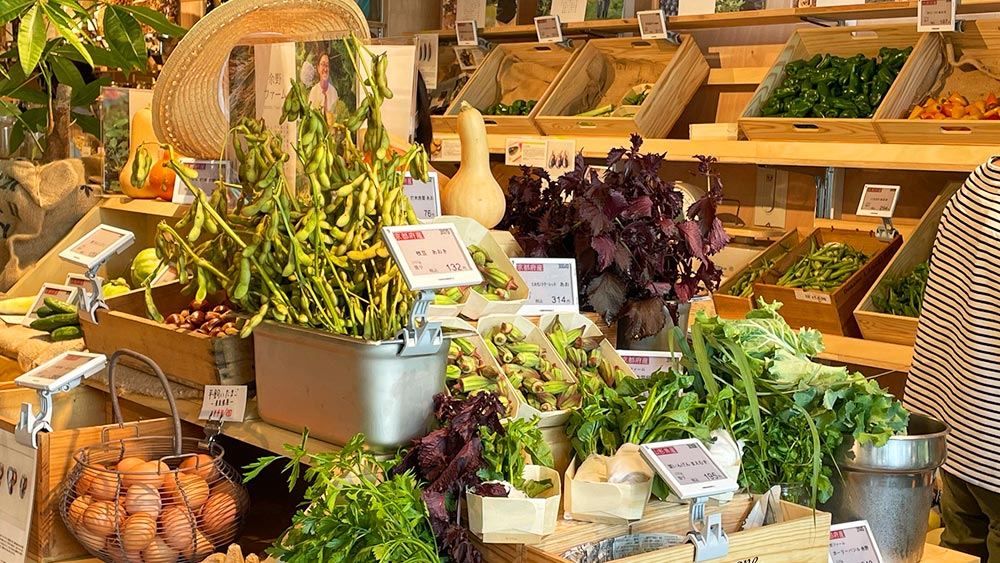
Mutsumi Uera is the owner of Zero-Waste Kyoto, she had a very calm and kind demeanor. This was my favorite store of the entire trip! The front of the store included typical zero waste shop items such as baht and body swaps as well as grocery items like produce, grains, and teas. Zero-waste grocery stores are far less common than their solely retail counterparts as I am guessing to be a factor of food codes and large grocery competitors. I absolutely love this place. The back half of the store is a cafe/bistro consisting of tables for seating and bar connected to the open kitchen.
Worked in finance at Capital Group for 15 years as a Pension & Strategy Consultant
Studied in Kobe
20 years ago, sustainability and zero-waste was not as common
Private debt is bad, environmental debt is more for next generation
Environmental Projects are hard to see, 'invisible'
Food is a big matter
She was a portfolio manager as well
She's very invested in healthy living and food
She bought a house in Kyoto & started a retreat for Indian medicine & massage
Oldest medicine
1 beta its called
Foods becoming a very serious matter
She contacted farmers & Producers
Rice is going up, Japanese scared, ministry is working on it
...
Japan gets imports from US and then Japan gets protection
Shes finding good local food
Stopping imports of food is impossible in the balance of priorities
Encourage slow shopping
...
Hard to find no additive products even organic
Fast food so convenient, so many additives, even mass producers
Price is hard to be environemtlaly friednly, taget waelthier people, not the mass populous, the system is built liek this
First two eyars of owning the shop was a struggle
6 years now better
Stalled in pandemic era
Buddhism encourages less waste, less spending
Habits/wisdom is influential, generational
Zero-waste not new
thousands of people have done
Bottom up approach would be best, if they like it then they can get into it
If you want a comfortable life you must think of the environment
Younger generations has better mindset for the environment
Older generations can help by teaching fermentation or even how to cook ice, passing down good habits
The world is still environmentally divided, even ...
No ...
Correlating with her emphasis on food, and the good surprise that this zero-waste store sells food, I sat down at the bar for lunch.
This store is truly a beautiful place, it is so tranquil and a vibe as soon as you first lay eyes on the building
Their food menu is simple, very welcoming & enjoyable, I love the in season selections & the ability to come at my convenience as there is no designated lunch or dinner hours, just the regular store hours
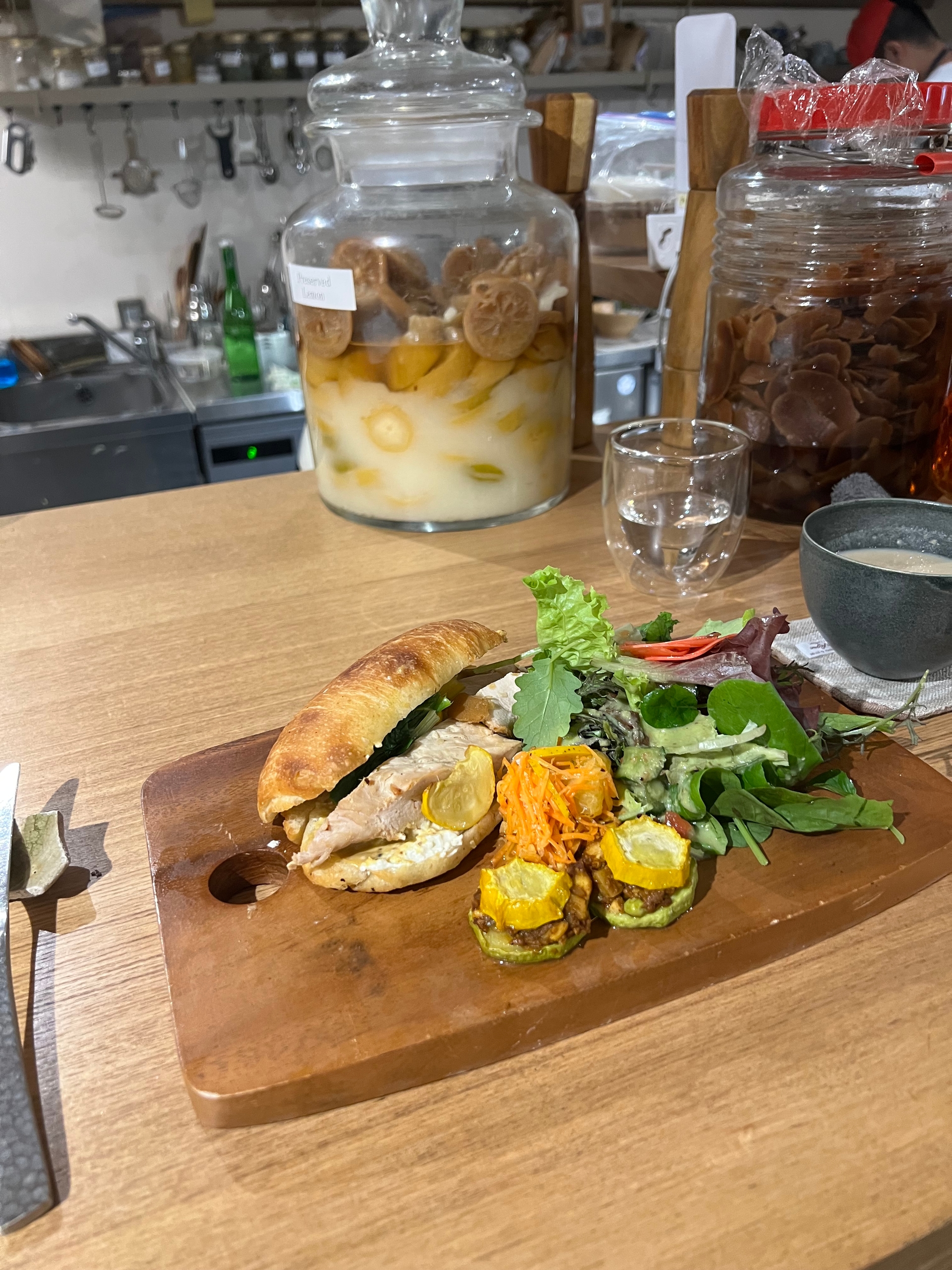
I ordered, for lunch; 'Chicken Sandwich' which consisted of local bread, vegan or chicken option, vegan sauce, gluten free available upon request. Paired with amazake (warm), a sweet drink made from fermented brown rice
I love this place
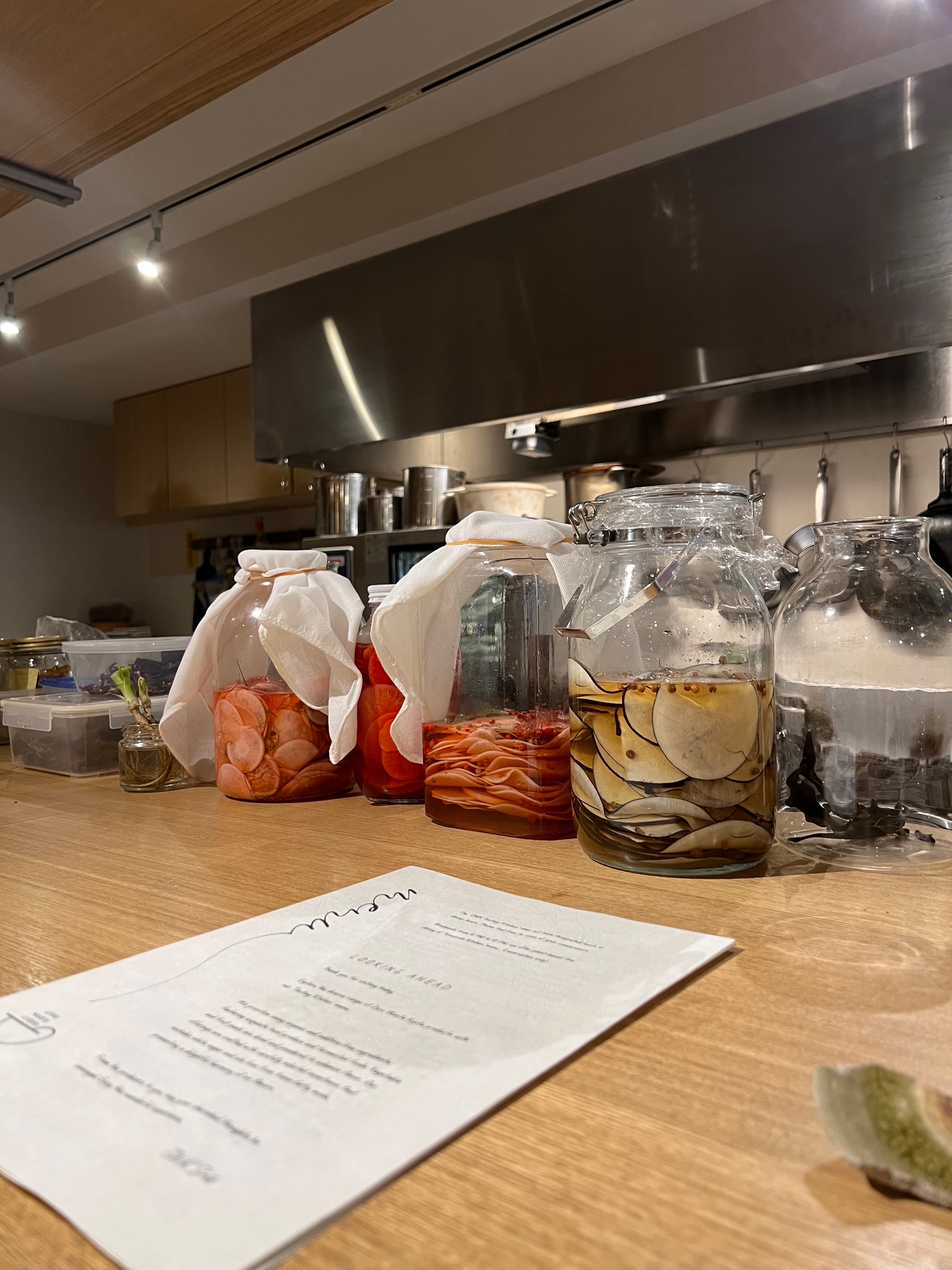
The quality of the design from the minimal and Japanese inspired decor to the jars of fermenting substances atop the bar counter, whatever those are. Zero waste stores have always brought me so much joy. Theres just something about them that makes me happy and comforted. I do hope I an have one of my own someday.
A store employee brought me mu utensils on a broken piece of ceramic bottom of a pot, how lovely.
I am very excited for this meal
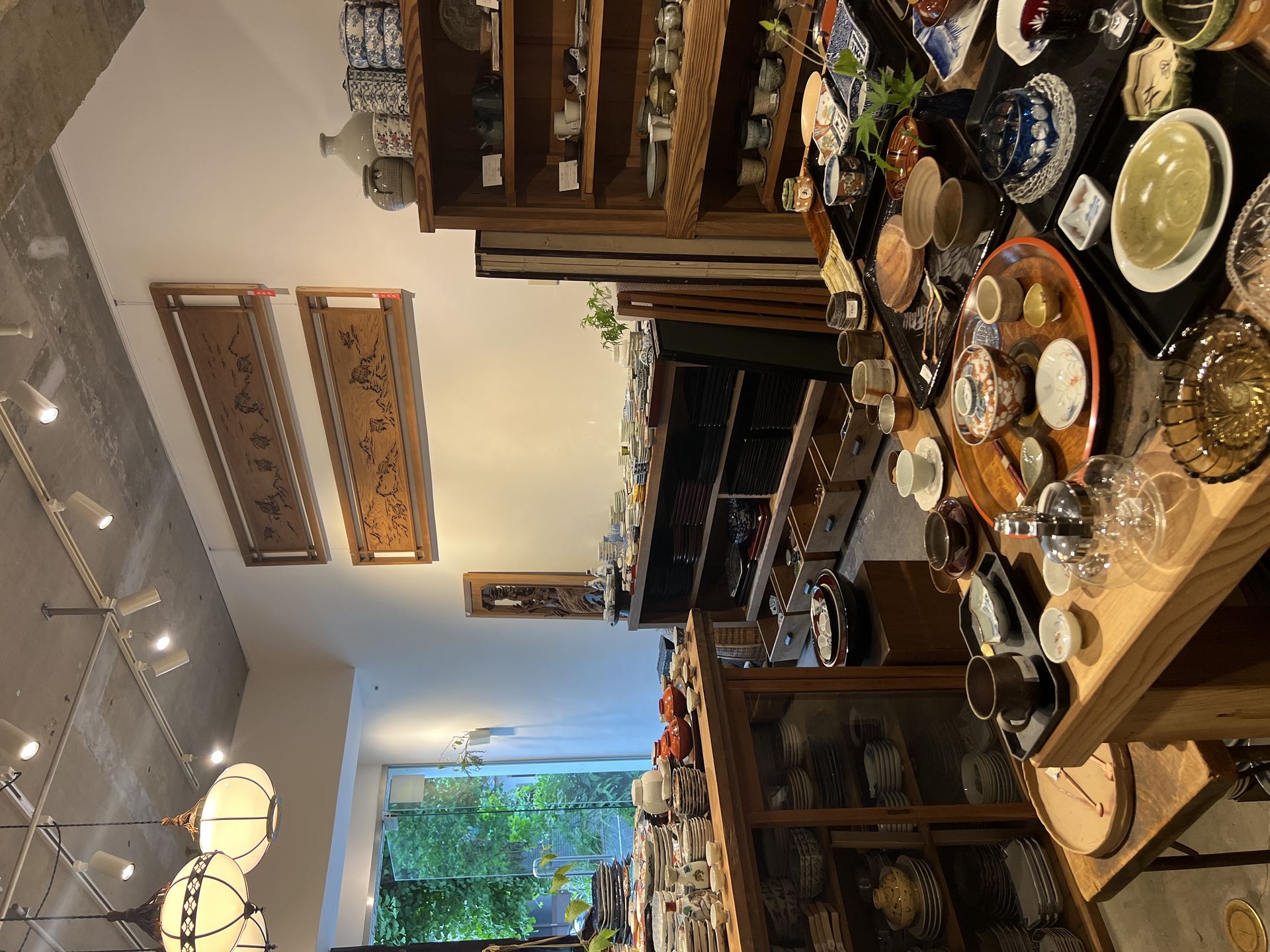
Don't get me started on ceramics, there such wonderful things, so much beauty in the tangible, handmade quality that brings peace and joy to the user that has mainly been taken away by mass production. The Amazake was a difference experience, its somewhat sour in the beginning but then sweet at the end. Its warmness is comforting, warm drinks will be very common on this trip. This drink reminds me of champurado.
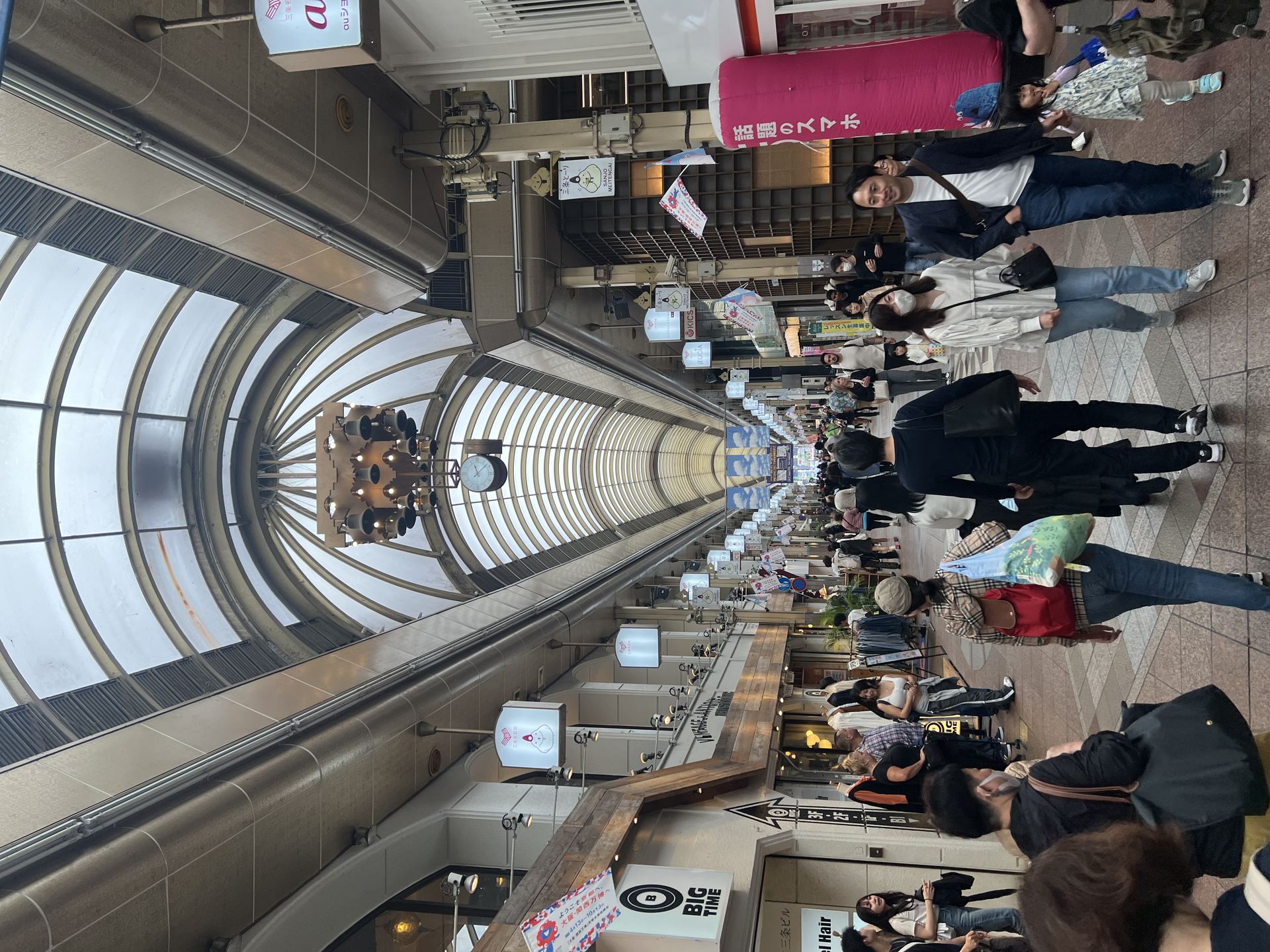
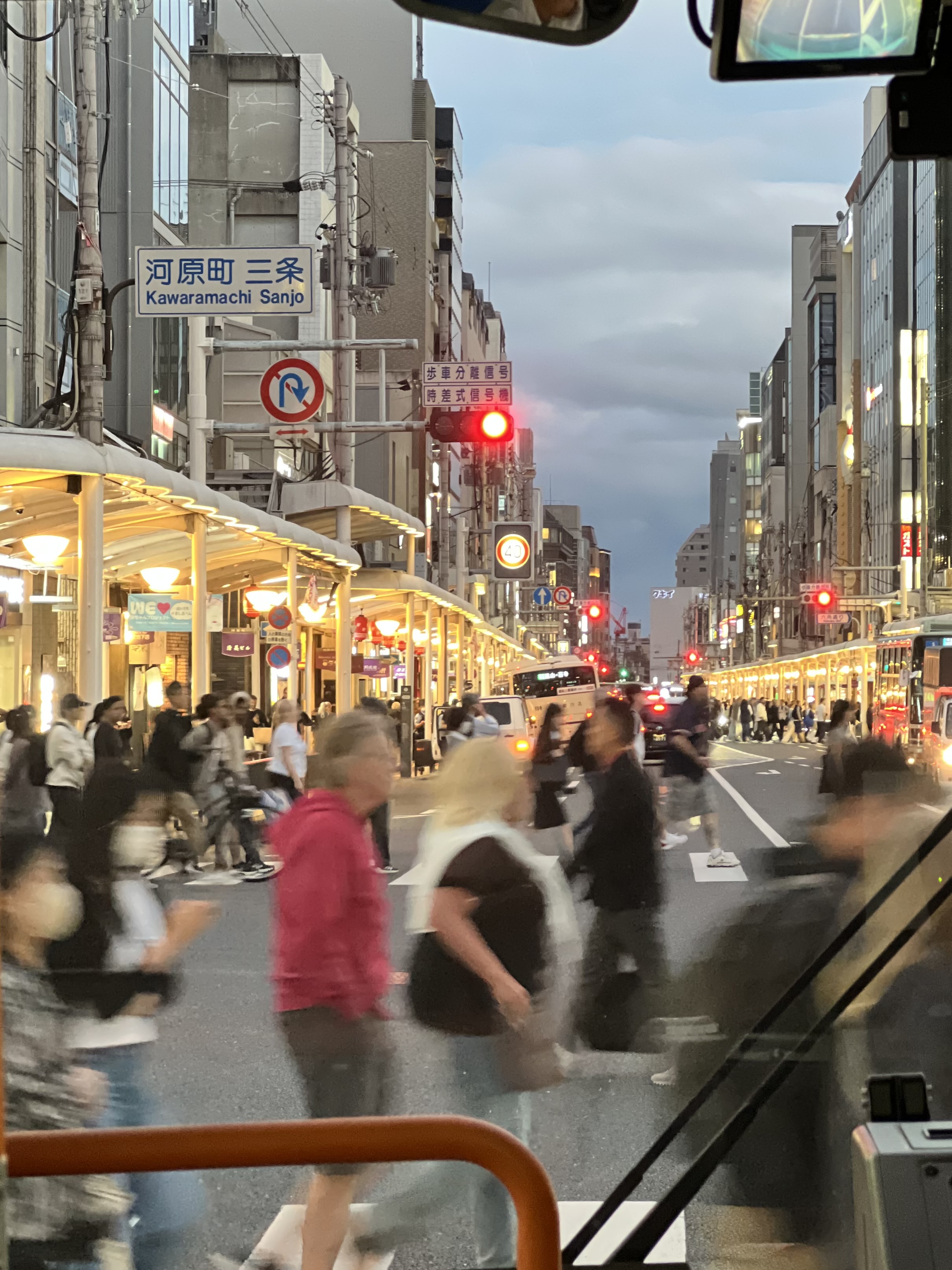
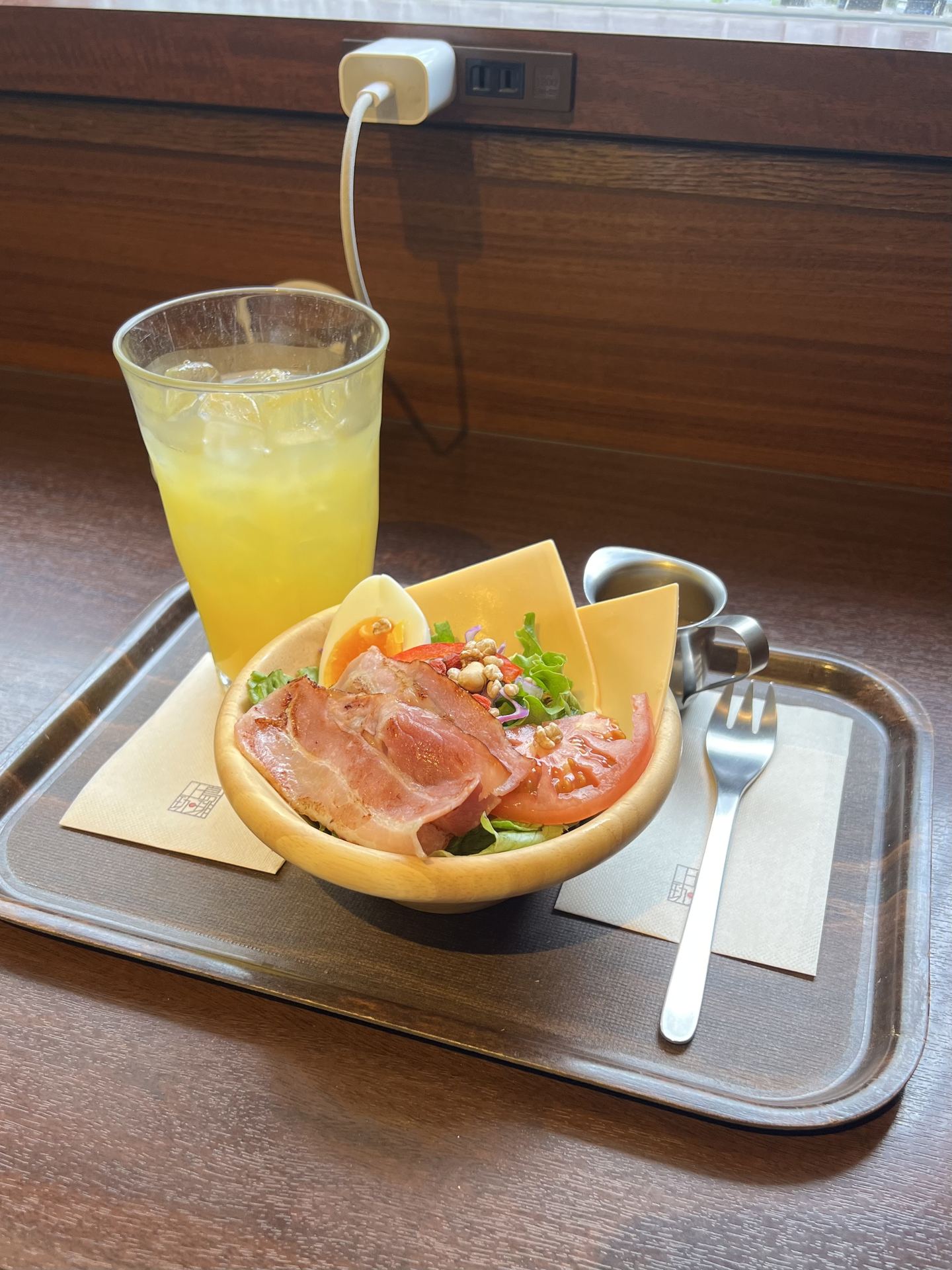
I am now at a coffee shop called St. Marc Cafe on the bustling street of Kawaramachi-dōri, the craziest commercial street I have seen in my life. My phone and portable charger were both on the verge of death so I stopped at htis cafe to charge them up. I knew I had to purchase something to be respectful to the cafe as I was goign to use their wifi and electricity. I had the perception that all dine-in and take-out would be in single-use disposables but to my surprise dine-in was in reusables. I ordered an iced tea and it came in a reusable plastic cup, so thats a plus!
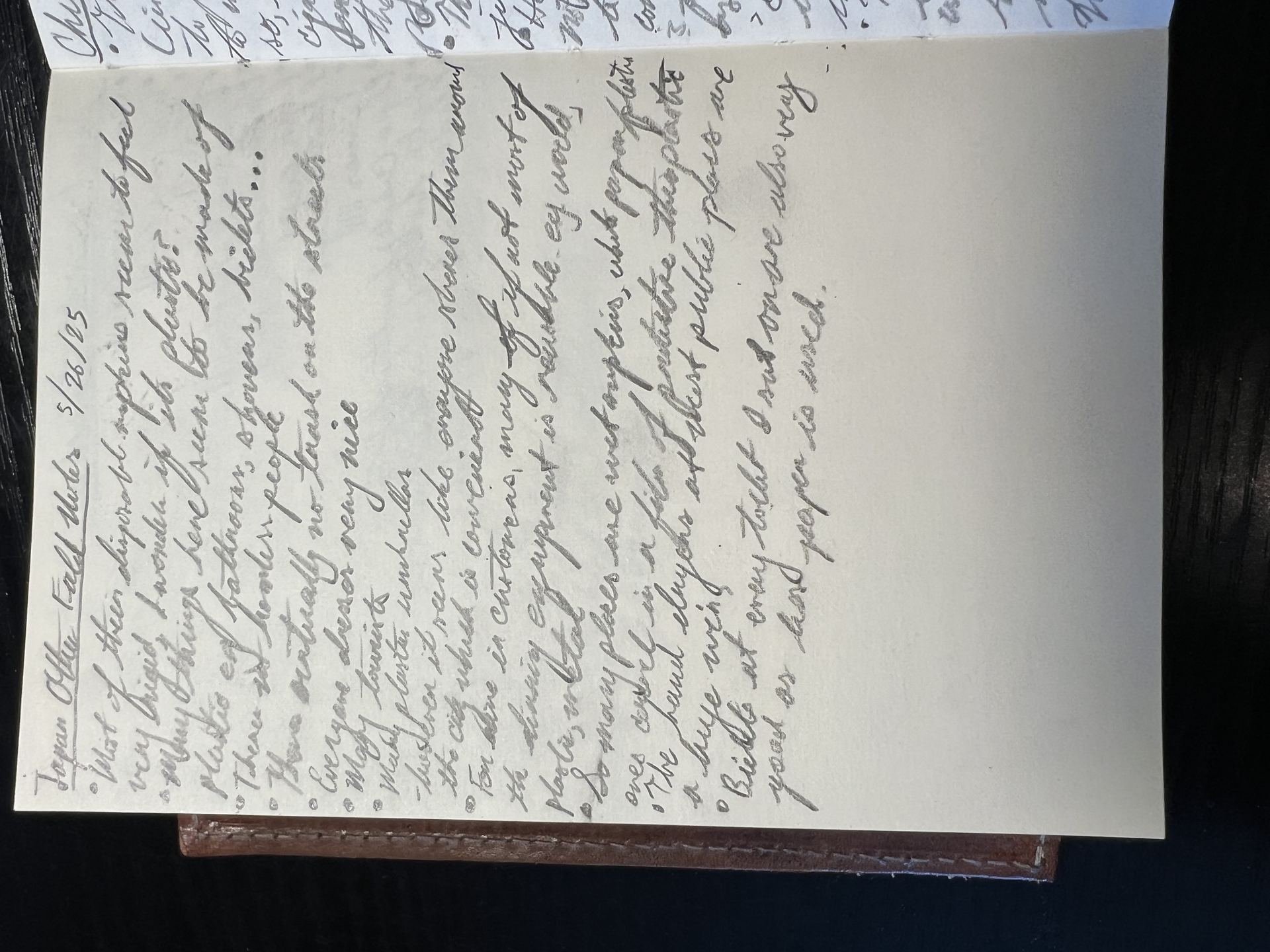
Other notes:
Most of their disposable napkins seem to be very rigid, I wonder if they contain plastic
Many things her seem to be made of plastics, such as bathrooms, showers, bidets...
I saw zero homeless people
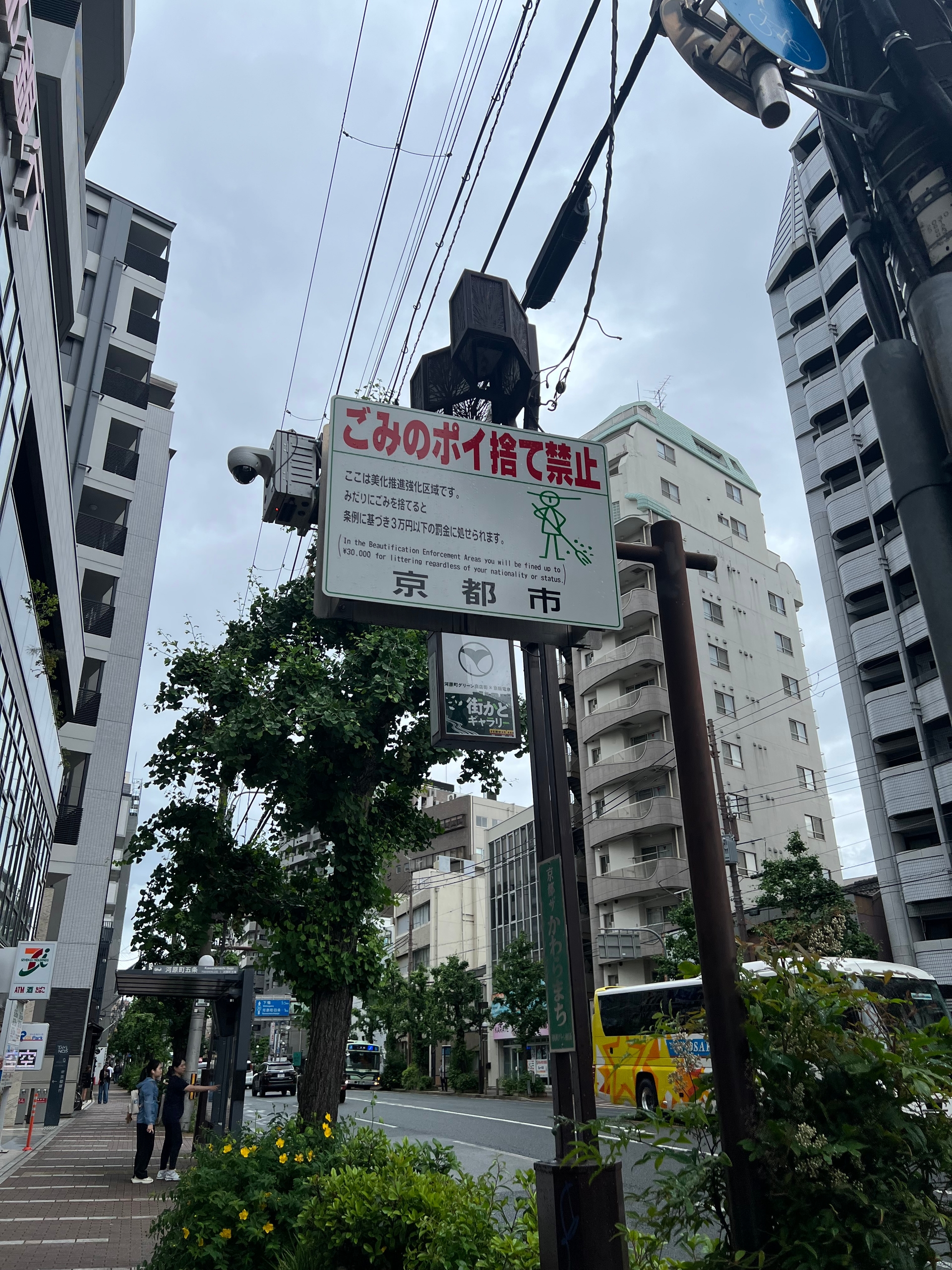
There was no trash on the streets or in sewers or gutters or anywhere, just in their respected bins
Everyone dresses very nicely
Many many tourists
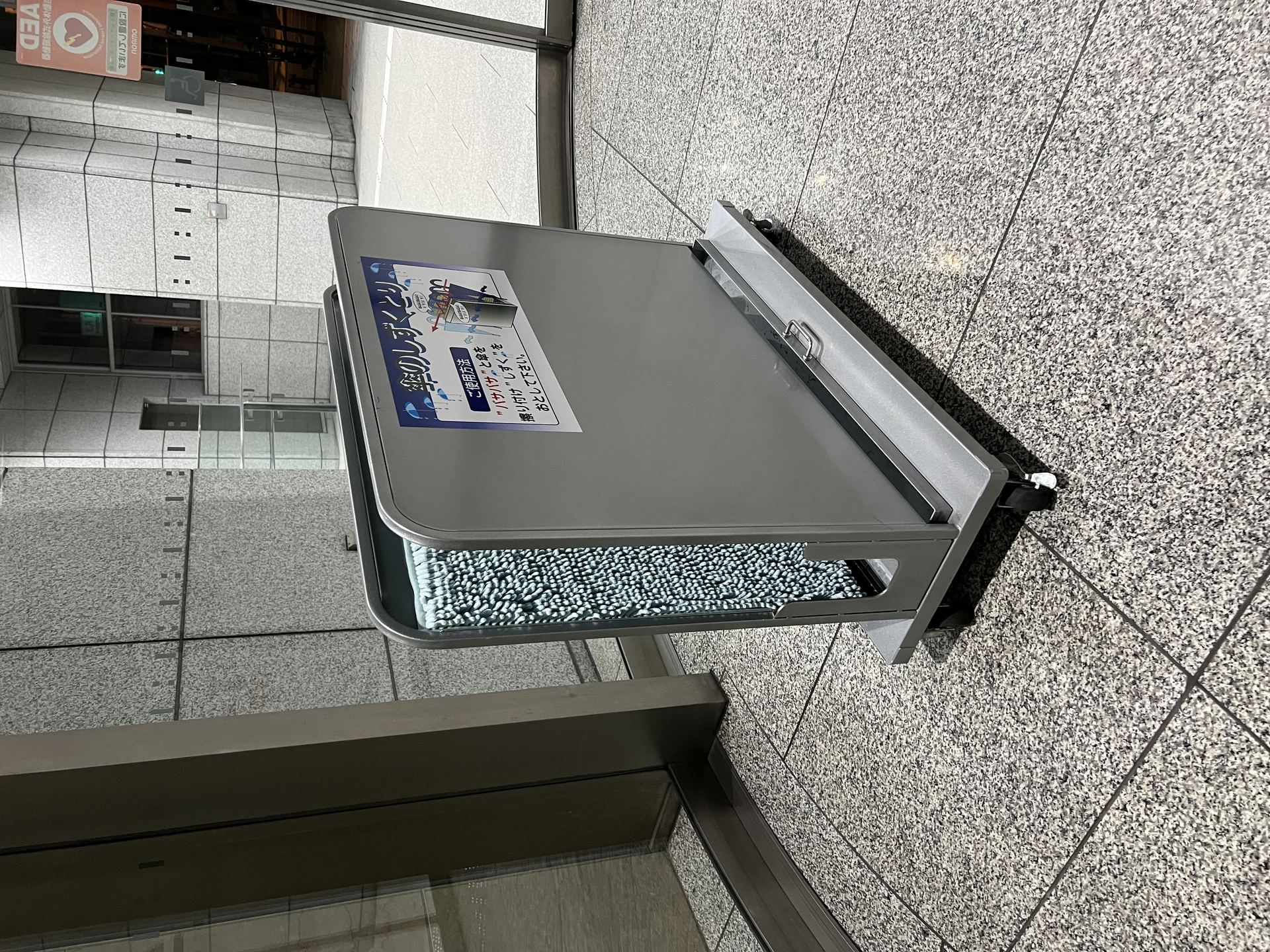
Many clear plastic umbrellas
I think that everyone shares them, like there communal umbrellas possibly and wherever you go there are umbrellas and you just pick them up and drop them off at your next destination
So many places use wet napkins, white paper/plastic ones covered in a thin film of protective plastic packaging
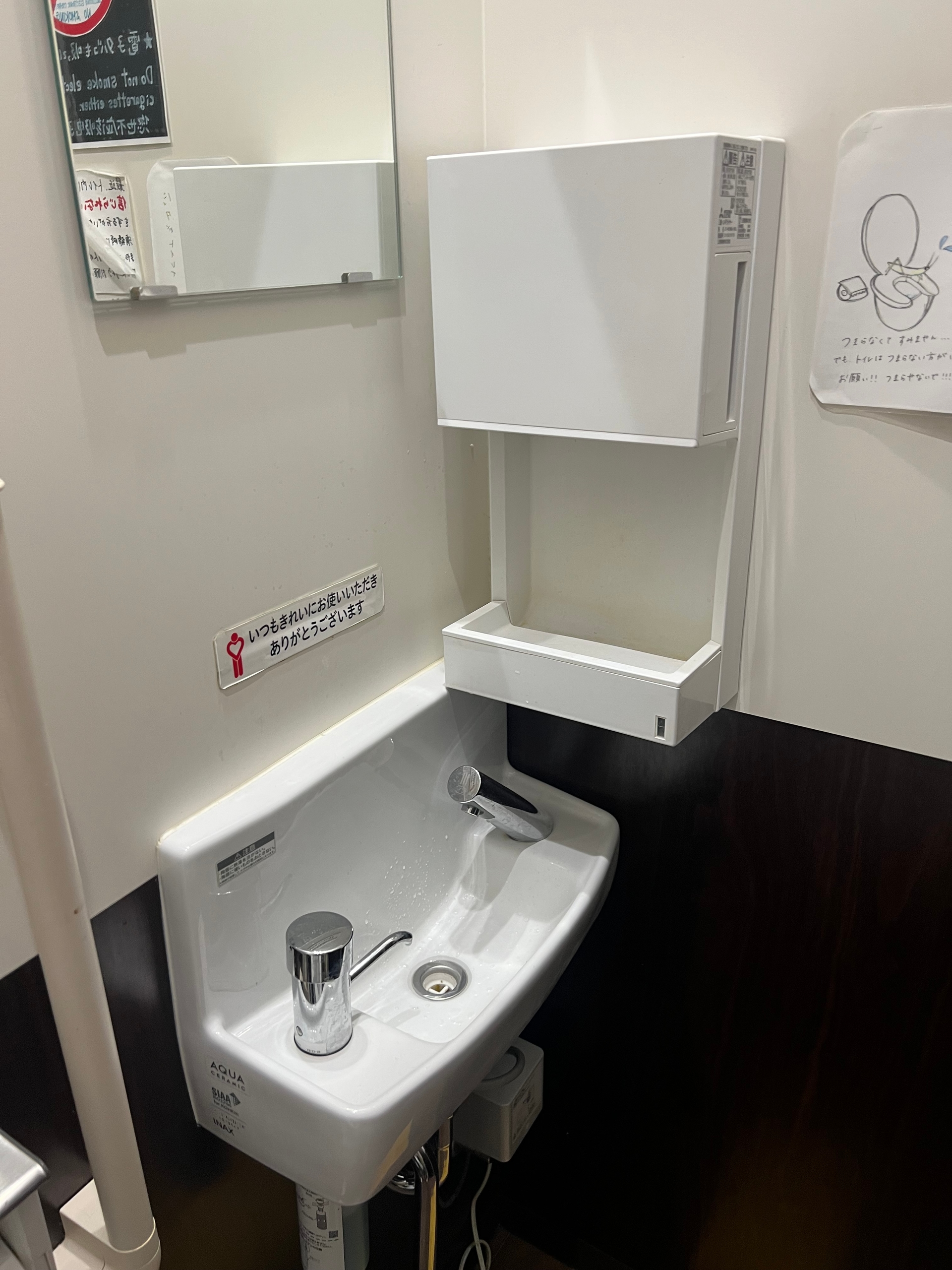
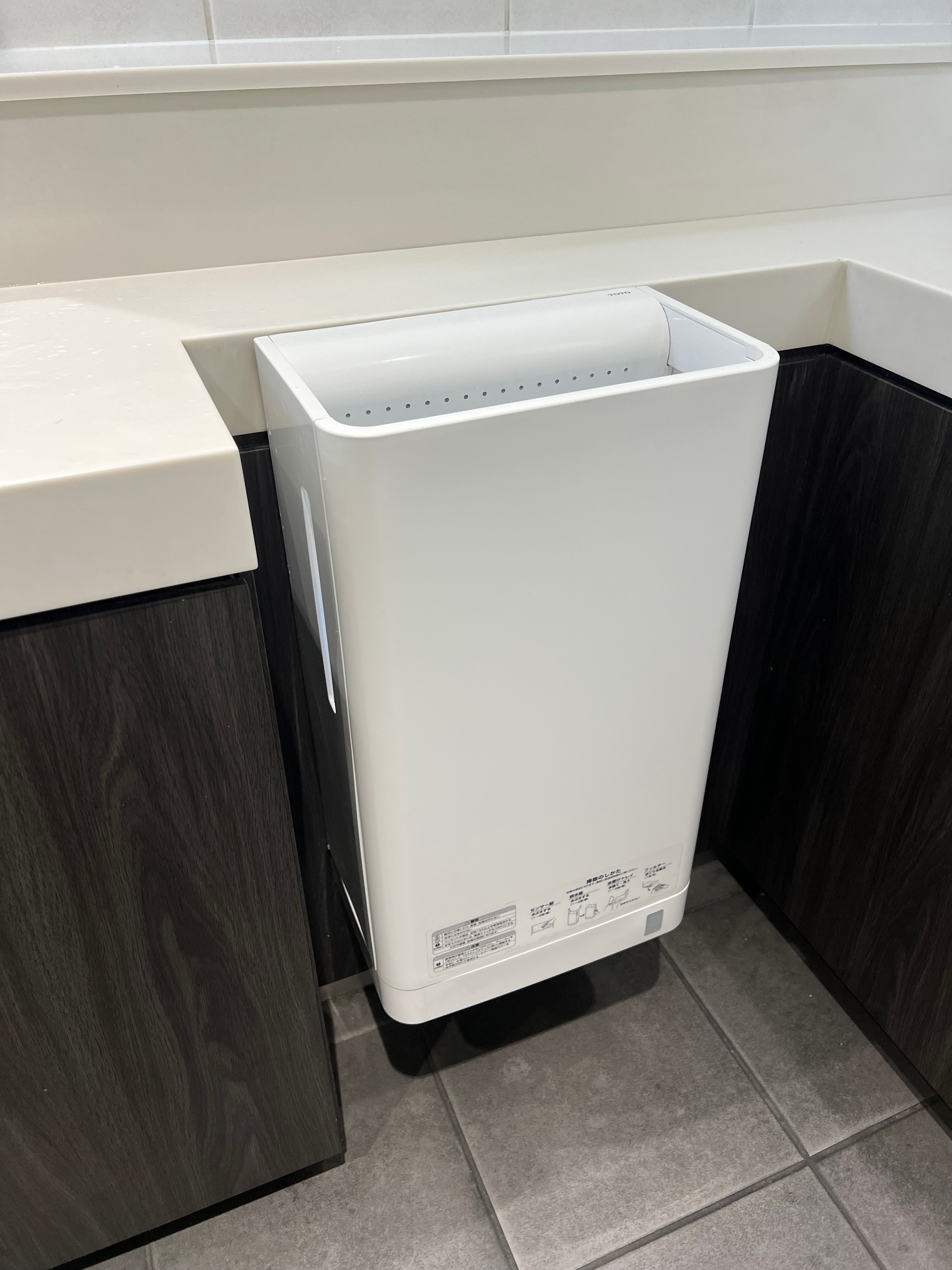
There are hand dryers at almost all places I went to, as well as bidets